
Comparison · Ad
Chilled water dispenser vs fridge filter jug: capacity, cooling and cleaning
Compare ready-cold water, recovery time, fridge space, counter clearance, electricity and cleaning for Lumi, Marella and Flow-style water storage.
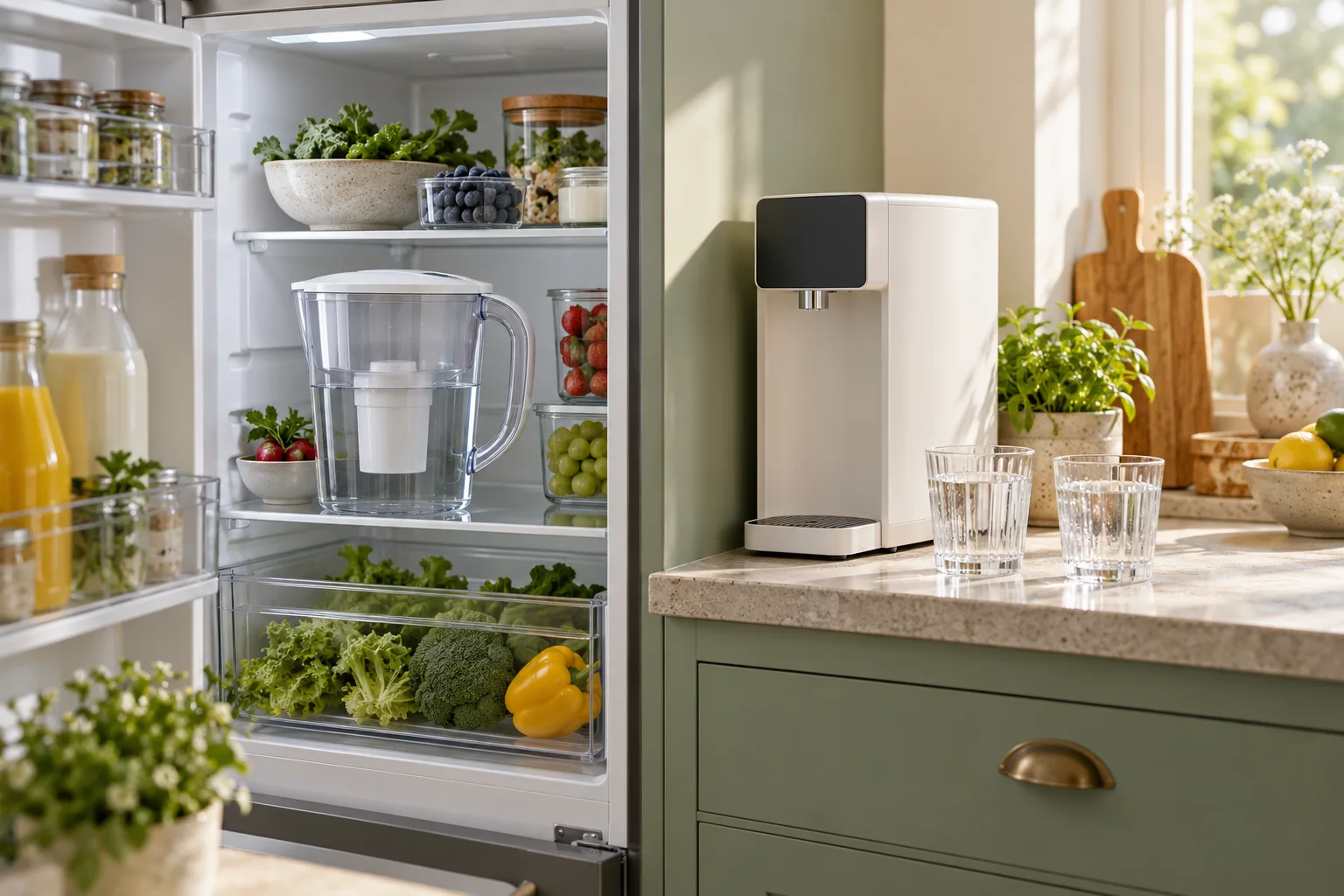
Count the cold water needed together
A countertop chiller and a fridge filter jug can both put cool drinking water within reach, but they store and replenish it differently. A jug relies on the refrigerator to cool its stored water. A chiller has its own refrigeration and usually a much smaller internal cold reserve than the total capacity advertised on the box.
Start with the busiest serving period. Two 750ml bottles need 1.5 litres together. Four 250ml glasses need one litre. Those demands are different from drinking the same volume over an afternoon, when a chiller has time to recover between pours. Daily litres alone do not tell you whether either arrangement will feel convenient.
This comparison uses Lumi as a chilled-dispenser example and Marella and Flow as fridge-storage examples. It does not assume their cartridges provide identical treatment, or that colder water has undergone stronger filtration. Choose the appropriate filter for the concern first, then compare where and how the water will be cooled.
Compare ready-cold storage with cooling recovery
Lumi’s internal chilled reserve is around 0.8 litres in the manufacturer manual, despite its much larger 8.2-litre total headline. Three 250ml glasses use 750ml, close to that nominal reserve. More water in the main vessel does not mean another full chilled batch is instantly ready at the outlet.
Aqua Optima Lumi WC0112 chiller
An electrically chilled countertop cartridge-filter dispenser with a small internal cold reserve and a much larger advertised total tank capacity.
- Capacity / pack
- Advertised 8.2L total · 0.8L chilled reserve
- System / cartridge
- Evolve+
Good forChilled serving without occupying a fridge shelf.
Watch forLatest Rev7 manual gives longer cooling times than the marketing page.
Choose it for repeated chilled glasses when counter space is available. Cooling recovery and the exact manual matter more than the headline total volume.
The latest Lumi Rev7 manual describes around 90 minutes initially and up to an hour to cool the full internal reserve subsequently, with conditions affecting the result. Marketing-page timings differ; use the documentation supplied for the exact unit and resolve a mismatch with the manufacturer. Do not promise a fixed temperature during repeated large pours.
| Arrangement | Relevant capacity | After refilling |
|---|---|---|
| Lumi chiller | Around 0.8L internal chilled reserve | Allow specified recovery |
| Marella 2.4L | 1.4L filtered storage | Fridge needs time to cool the new fill |
| Flow 8.2L | 5.2L filtered storage | Large storage still needs refrigeration time |
A fridge jug can have its full filtered volume cold after sufficient refrigeration, but a fresh refill changes that temperature. Neither the 1.4-litre Marella figure nor the 5.2-litre Flow figure is a cooling-speed guarantee. Keep a realistic refill schedule rather than repeatedly mixing warm incoming water into the last cold portion.
Choose which storage space you can spare
A small jug uses fridge space and needs to be lifted for pouring. Marella’s 1.4 litres of filtered storage may suit occasional glasses, while larger bottle filling means more frequent preparation. Measure the door pocket or shelf with the fridge closed and check handle access; a jug can fit physically yet be awkward to remove past nearby food.
BRITA Marella 2.4L
A sensible starting point when a fridge-door jug and a widely stocked cartridge family matter more than a large reservoir.
- Filtered / total
- 1.4 / 2.4L
- Depth
- 10.5cm
- Cartridge
- MAXTRA PRO
Good forFridge-door storage and everyday pours.
Watch forTwo large bottles can mean another refill.
Choose it for a small household; its 1.4-litre filtered capacity means more refills when several people pour at once.
Flow offers a larger filtered reservoir with a tap, but requires substantial shelf space and a convenient dispensing position. Measure depth, width, height and the projecting tap, plus room for a glass. Do not balance a vessel partly off a shelf or plan to drag a heavy full tank forward for every serving.
BRITA Flow 8.2L dispenser
A dispensing tank to consider when several people pour from the same place. Its larger reservoir offers more filtered water between refills than the jugs in our shortlist.
- Filtered / total
- 5.2 / 8.2L
- Format
- Dispensing tank
- Cartridge
- MAXTRA PRO
Good forServing several glasses without lifting a full jug.
Watch forShelf space, full weight and access for cleaning.
Check a stable shelf, room above the sliding lid and space below the dispensing tap. A larger tank still uses a MAXTRA PRO cartridge with its own replacement limit.
A chiller moves that storage and serving task onto the counter. Add ventilation, tank lift-out and receiving-vessel clearance to its body dimensions. Consider whether the route to the sink is clear for cleaning and whether the outlet can be used without standing beside a hot hob or obstructing another appliance. Saving fridge space is useful only when the worktop arrangement remains practical.
Compare wet parts and cartridge schedules
For the jug side of the comparison, the component cleaning guide separates the body, funnel, lid and electronic reminder. Those washing instructions should not be transferred to a powered chiller.
A jug normally has a body, funnel, lid and cartridge to manage. A dispenser can add an internal chilled reservoir, outlet, drip tray and drain plug. Cleaning the visible top tank does not necessarily refresh the hidden water path. Use the manufacturer’s specific cleaning and non-use instructions for each arrangement.
Lumi Rev7 requires regular washing, rinsing and drying of removable tanks and lid, at least at cartridge changes, and says not to use washing-up liquid or anything that could taint the water. That is a model-specific rule. Do not copy a detergent or dishwasher instruction from a different jug onto an electrical chiller.
Aqua Optima Evolve+ · 6 pack
The Evolve+ replacement family for compatible Aqua Optima jugs and dispensers. Check the device instructions and whether one cartridge or a pair is installed.
- Pack
- 6 cartridges
- Family
- Evolve+
- Limit
- 100L / 30 days
Good forMaintaining a confirmed compatible Aqua Optima device.
Watch forDevice instructions and paired systems can change the replacement calculation.
For a PerfectFit BRITA jug, check the compatibility key is included and follow Aqua Optima’s fit guidance. Do not assume any oval cartridge will work.
Its Evolve+ schedule is 100 litres or 30 days, whichever comes first. A fridge jug using MAXTRA PRO has its own cartridge schedule and capacity limits. Compare current pack prices using your actual volume, rather than assuming every cartridge lasts a calendar month. The running-cost resource explains this distinction.
Keep all drinking water fresh. Lumi’s cited manual gives a two-day use recommendation and a specific restart after more than 48 hours without use. For a jug, use the fridge storage guide and the exact manufacturer instructions. Refrigeration slows some deterioration; it does not eliminate cleaning or justify indefinite storage.
Include electricity without inventing a saving
A chiller consumes electricity for its own cooling and controls. A jug has no electrical connection, but the refrigerator still supplies its cooling. Calling fridge-filtered water free to chill ignores the refrigerator, while assigning an arbitrary share of the whole fridge bill to one jug exaggerates what can be known without measurement.
For a fair household comparison, consider whether the fridge is already running, how much water is cooled, starting temperature, serving pattern and the new chiller’s actual consumption. A rated wattage is not a daily kWh figure because operating time and cycling matter. Add cartridge purchases and any delivery or accessory costs separately.
Choose a fridge jug when shelf space is available and a prepared batch meets your demand. Consider a chiller when repeated accessible glasses and freeing fridge space justify its worktop footprint and extra care. For large consecutive bottle fills, verify recovery or plan chilled storage ahead; neither a large total tank nor a cold-water label removes that bottleneck.
Common questions
Will a large chiller keep every glass cold during a party?
Not necessarily. The internal chilled reserve may be much smaller than total storage. Plan consecutive servings and the manufacturer’s recovery time, rather than relying on the headline litres.
Does a fridge jug need a separate electrical connection?
No. The jug itself does not, but cooling still uses the refrigerator. Its energy demand is not literally zero and depends on the fridge and use.
Can a filter jug be filled with warm water to cool faster later?
Use the cold-water source specified by its manufacturer. Filtering and refrigeration are separate steps; do not use hot water to speed up a routine.
Is a chiller filter better because the water is colder?
No. Temperature and treatment performance are different. Compare the exact cartridge and documented claims for the concern you want to address.
Which takes more cleaning?
A jug usually has fewer accessible wet parts. A chiller adds an outlet, drip tray and internal chilled reservoir with its own draining and restart instructions.