
Maintenance guide · Ad
How to clean ceramic water filter candles—and when to replace them
Clean British Berkefeld ceramic candles without soap, protect the outlet and know when capacity, age, damage or persistent flow problems require replacement.
First decide whether cleaning is appropriate
A ceramic candle can collect particles on its outer surface and gradually pass water more slowly. For the British Berkefeld Ultra Sterasyl and Ultra Fluoride grades discussed here, the manufacturer provides a surface-cleaning method to help recover flow within the candle’s service life. That does not make cleaning the answer to every water-quality or installation problem.
Check the grade, start month, use record and physical condition before removing anything. A candle already due for replacement should not be given a new six-month period because its surface can be brushed. A cracked body, damaged mount or suspected contamination also requires a different decision from ordinary surface fouling.
If the lower tank contains plenty of water but the tap runs poorly, check the dispensing component first. A slow outlet is not the same as slow filtration through the ceramic. Our gravity-flow guide separates those two symptoms before recommending a cleaning or replacement purchase.
| Finding | Next step |
|---|---|
| Gradual slowing within the service period | Check water level and conditioning, then clean if appropriate |
| Candle at time or capacity limit | Fit the correct replacement; cleaning does not reset life |
| Crack, damaged stem or suspected impact damage | Stop using the suspect element and obtain replacement or assessment |
| Lower tank full but weak dispensing | Inspect the tap path rather than scrubbing candles repeatedly |
| Changed water or suspected contamination | Stop and investigate the source and clean-side handling |
Clean the ceramic gently and protect the outlet
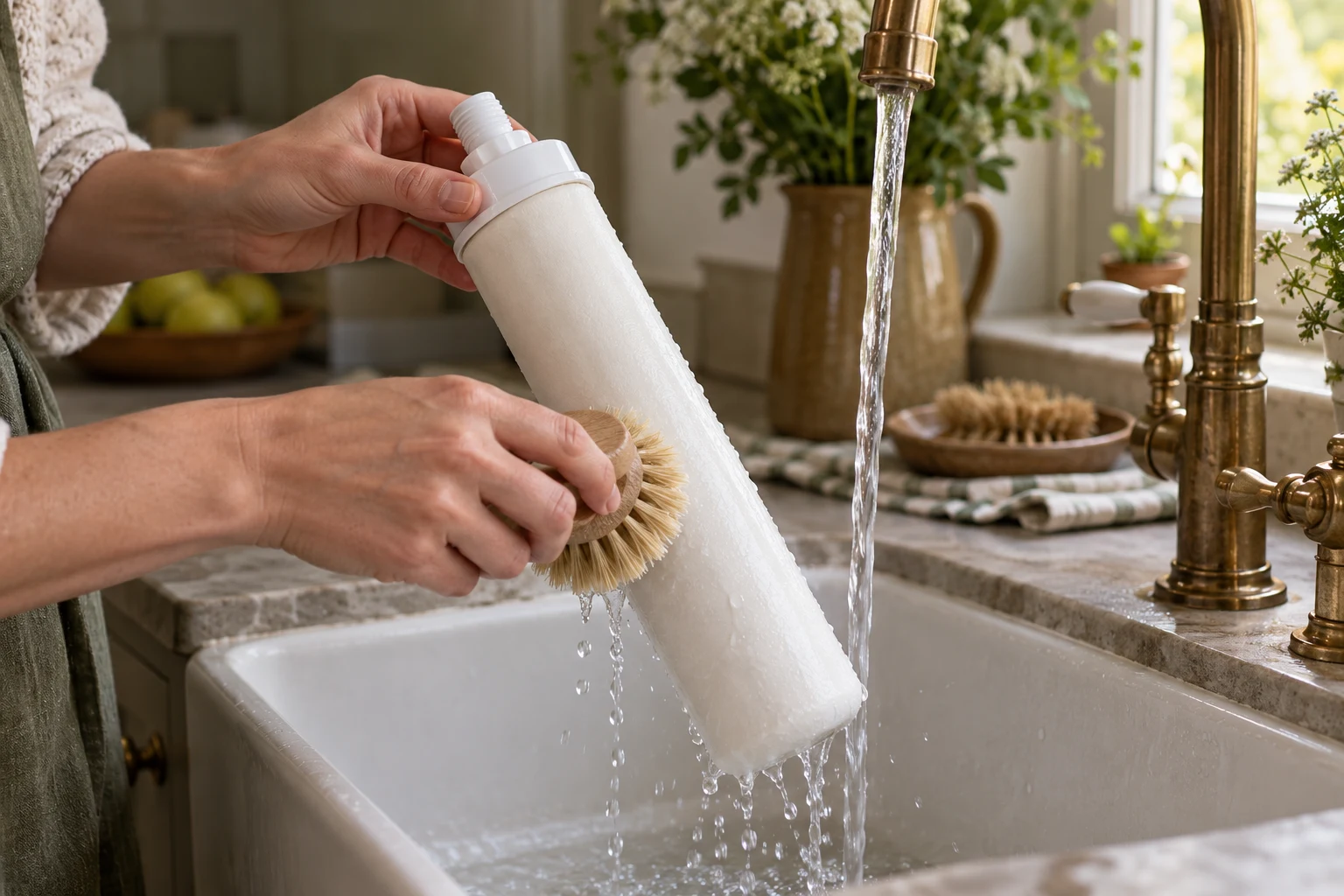
Empty the system, wash your hands and arrange a clean surface for components. Remove the candles using the housing instructions, keeping washers and wing nuts together. Protect the open plastic threaded outlet: it leads to the filtered side and should not sit in dirty sink or bowl water.
- Hold the candle so its outlet stays clear of the cleaning water. Work over a clean sink or use the arrangement specified in the manual.
- Use running water and the permitted soft-bristled brush or lightly abrasive pad on the ceramic surface.
- Apply gentle pressure evenly around the circumference and down the length, rather than concentrating on one patch.
- Rinse away loosened deposits without directing dirty water into the plastic outlet.
- Set the candle aside on a clean surface while the housing and fittings receive their separate wash.
The system instructions explicitly prohibit soap or detergent on the ceramic. Do not soak the candle in the housing’s washing-up water, boil it or add an improvised chemical descaling or sanitising recipe. The approved surface-cleaning routine is not a media-regeneration process.
Avoid aggressive sanding to make an old candle look newly white. Physical material removal is not the same as restoring internal treatment capacity, and excess force can damage the element. If gentle permitted cleaning does not produce a usable result, stop repeating it and check replacement or manufacturer advice.
Clean the housing separately, then refit and flush
With candles removed, the steel housing guide covers the chambers, tap, washers and nuts. Rinse and dry those parts as directed. Keep cloths used for untreated-water spills away from the lower reservoir and candle outlets.
Inspect each sealing washer before refitting. Place it correctly on the mount, secure the candle according to the diagram and do not overtighten the wing nut. Unused supported positions need the specified blanking parts. A seal problem can allow bypass even when the outside of the tank stays dry.
For cleaned candles being refitted, the system instructions call for one litre per candle to run to waste. Two refitted candles mean at least two litres; four mean at least four litres. This is a post-clean routine, not a substitute for the fuller conditioning sequence when fitting new candles.
Observe the reassembled unit for normal filtering and dispensing. A sudden increase after disturbing a seal is not automatically a successful clean: first rule out an unintended route around the candle. Do not judge treatment integrity by speed alone.
Replace by the applicable limits, not surface appearance
Doulton recommends changing the named gravity candles every six months, while the exact leaflet and performance conditions also set capacity requirements. Keep the instructions for the fitted version and apply any earlier limit. Water conditions and actual use can make replacement necessary sooner.
The candle leaflets list 1500 litres for these grades under their specified conditions. That is not a universal promise that a complete household system will serve an arbitrarily multiplied volume. Keep per-element figures, fitted count, system evidence and actual replacement instructions separate.
Internal media cannot be assessed completely by looking at the ceramic. Clear water, restored flow or an acceptable taste does not prove every reduction remains within specification. A TDS meter likewise cannot independently establish remaining chlorine, fluoride or other contaminant-reduction performance.
Take a suspect damaged candle out of service. A visible crack, failed mounting part or unexplained issue after an impact should not be repaired with adhesive or accepted after an improvised integrity test. The identification directory helps find the correct replacement family.
Buy a matched grade and a complete replacement quantity
Ultra Sterasyl 8674 / W9121226 and Ultra Fluoride 8B76 / W9120133 are different choices. Use the grade specified for the supported installation, and do not combine them in one tank. These are gravity elements, not Biotect Ultra M12 replacements for under-sink equipment.
British Berkefeld Ultra Sterasyl 8674, two-pack
Two British Berkefeld Ultra Sterasyl ceramic gravity candles, with the documented 8674 identity; a replacement pair for a correctly matched system.
- Identity
- 8674 / W9121226
- Pack
- 2 gravity candles
Good forReplacing a confirmed Ultra Sterasyl pair.
Watch forNot Biotect Ultra; do not mix with Ultra Fluoride.
Choose for the confirmed gravity housing and same-grade configuration. Cleaning may restore flow but does not reset the replacement schedule.
British Berkefeld Ultra Fluoride 8B76, two-pack
Two British Berkefeld Ultra Fluoride gravity candles for an identified compatible system and a specific fluoride-reduction purpose.
- Identity
- 8B76 / W9120133
- Pack
- 2 gravity candles
Good forConfirmed Ultra Fluoride replacement route.
Watch forRetail WRAS wording does not prove a contaminant-removal claim.
Match the 8B76 identity and maintain a same-grade configuration. Follow the exact capacity, time and preparation instructions.
A two-pack provides one full change for a two-candle system. Four installed candles require four at a complete change. Price the actual event and planned interval rather than assuming a pack count is a number of years. For a change of grade, read Ultra Sterasyl vs Ultra Fluoride before ordering.
Common questions
Can I use soap to clean a ceramic candle?
No. British Berkefeld’s gravity-system instructions explicitly prohibit soap or detergent on the ceramic. The separate hot-soapy-water routine is for the housing and approved fittings with candles removed.
Should I scrub until every mark disappears?
No. Follow the gentle, even cleaning method rather than aggressive polishing or sanding. A visual colour change is not a complete measure of treatment performance.
Can cleaning make a six-month-old candle new again?
No. Surface cleaning does not regenerate internal carbon or other media, erase capacity already used or reset the original start month.
What should I do with a cracked or dropped candle?
Take it out of use if damage is known or suspected and obtain a correct replacement or manufacturer assessment. Do not rely on a home bubble or dye test as proof that it is safe to keep using.
Can I replace one Ultra Sterasyl with Ultra Fluoride?
Doulton advises against mixing those grades in one installation. Identify the housing and complete supported same-grade configuration before changing the media choice.
Sources and further reading
- British Berkefeld: stainless-steel gravity system operating and cleaning instructions
- British Berkefeld: exact 8.5L SS2 Ultra Sterasyl system instructions and performance sheet
- British Berkefeld: Ultra Sterasyl 8674 replacement specification
- British Berkefeld: Ultra Fluoride 8B76, conditional testing and replacement guidance
- British Berkefeld: Ultra Fluoride candle preparation and care instructions