
Water measurement explainer · Ad
What a TDS meter can—and cannot—tell you about drinking water
Understand conductivity-derived TDS readings, why carbon filters may leave them unchanged, and how to use a meter without mistaking it for a safety test.
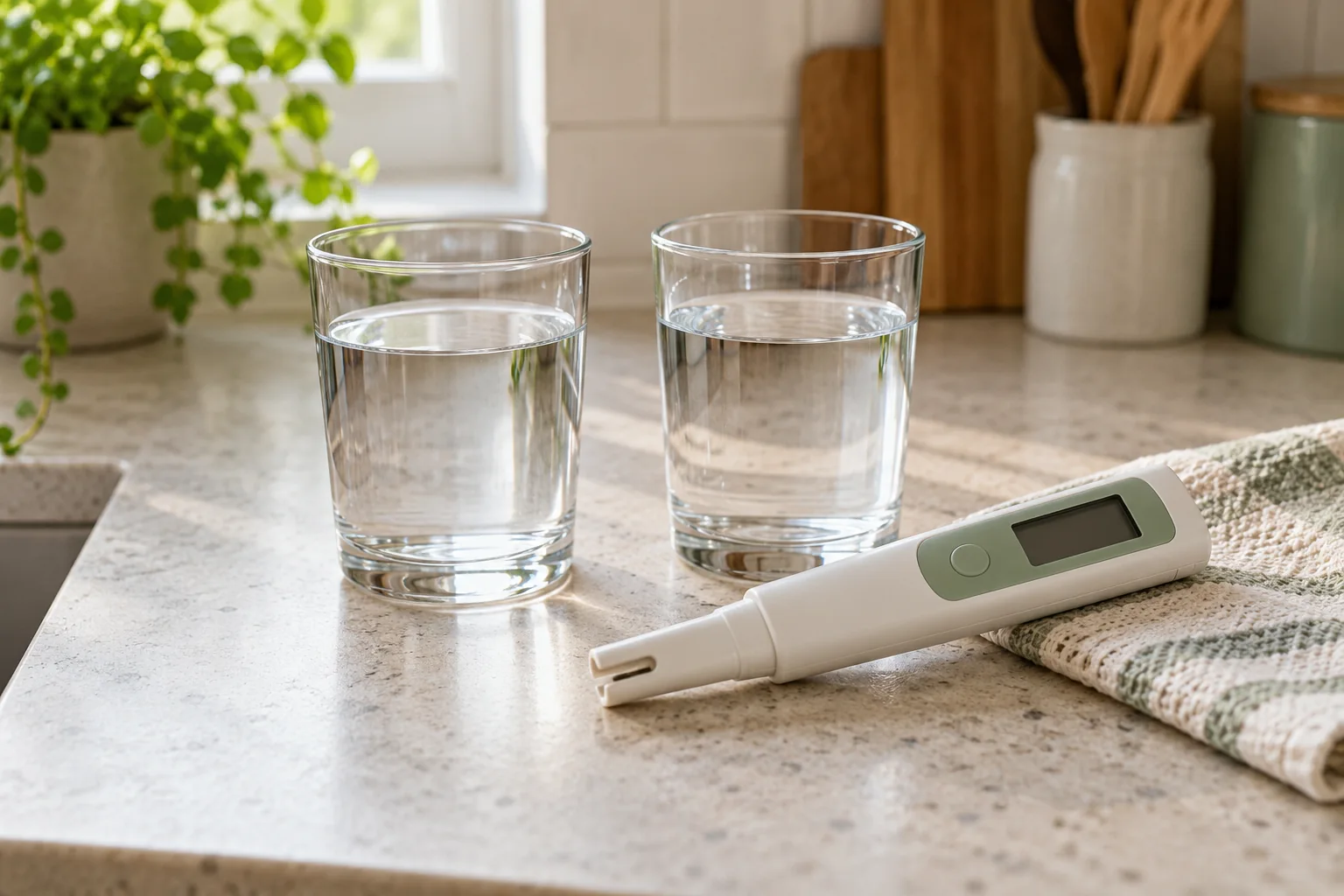
What does the number on a handheld TDS meter represent?
TDS stands for total dissolved solids. Laboratory methods and handheld meters do not obtain that result in the same way. A common pocket meter responds to the water’s ability to conduct electricity, then applies a conversion to display an estimated concentration, often labelled ppm.
Dissolved ions contribute to conductivity. Which ions are present, their proportions, the temperature and the meter’s assumptions affect the relationship between conductivity and the displayed estimate. A factory-calibrated instrument can provide useful consistent readings for its intended task without identifying the individual substances in the sample.
This is why a display should not be called a “contamination score”. Ordinary mineral ions contribute to it, while a substance of concern may be present at a concentration the reading cannot distinguish. The number does not separate desirable minerals from a pollutant or explain the cause of an unexpected supply change.
| Question | What the meter can contribute | What it cannot establish |
|---|---|---|
| Did the conductivity-derived estimate change? | A repeatable numerical comparison | Which substance changed |
| Is the water safe to drink? | No complete safety assessment | Absence of pathogens or harmful chemicals |
| Has a carbon taste filter worked? | Possibly little change in estimated TDS | Chlorine-reduction performance or remaining media life |
| Is this water hard? | No exact calcium/magnesium result | A total-hardness value or appliance setting |
| Is an RO process behaving differently? | A trend under controlled sampling conditions | Every contaminant reduction or a maintenance exemption |
Choose a meter for a defined monitoring task
If a system manual calls for TDS monitoring, an identifiable meter with instructions and a calibration route is more useful than an unlabelled device chosen for a dramatic colour chart. Decide what comparison you need before buying: a process trend, a troubleshooting record or a specific manufacturer check.
HM Digital TDS-3 meter with case
A handheld meter for conductivity-derived TDS estimates and repeatable readings under the maker’s instructions.
- Model
- TDS-3
- Reading
- Estimated TDS
- Includes
- Carrying case
Good forFor a defined TDS monitoring task
Watch forA low reading cannot certify water safety.
An optional process-check tool, not a drinking-water safety, lead, bacteria, chlorine or hardness test.
HM Digital identifies the TDS-3 as factory calibrated using a sodium-chloride reference solution and provides model-specific care information. Follow those instructions for checking calibration, probe immersion and storage. Do not assume the whole body is waterproof or use an arbitrary household liquid as a calibration standard.
The seller and authenticity matter, particularly for a widely copied instrument. Confirm the selected listing is the intended model and includes the stated case. Use the meter only for the measurements described in its instructions; a TDS reading cannot establish drinking-water safety.
If your question is lead, microorganisms, a named chemical or unexplained water quality, ask the supplier or an appropriate accredited laboratory about the necessary sampling and analysis. Buying a conductivity meter does not replace that investigation.
Make a comparison consistent before interpreting it
Use clean suitable containers and follow the meter’s sampling procedure. Residue from detergent, salt, a previous drink or fingers can alter a small sample. Keep samples identifiable and avoid treating water that has stood in different conditions as a controlled before-and-after comparison.
Allow the instrument and sample to behave as its manual specifies, including temperature handling and a stable reading. A warm kettle sample and a cool tap sample are a poor basis for judging a cartridge. Automatic temperature compensation helps within its design limits; it does not correct dirty containers, a changed sampling point or an unsuitable calibration.
Record the source, sampling point, units, relevant system condition and result. Repeating the same procedure is more informative than comparing an isolated number with a stranger’s online photograph. If results are inconsistent, check the method and instrument guidance before blaming the filter.
For a supply concern, do not taste the samples to decide whether the number is reassuring. Describe the observations to the supplier and follow its instructions, including any official notice. A clear glass and a low display cannot certify safety.
Why taste filtration may leave the number almost unchanged
A taste-focused filter can reduce chlorine-related substances while retaining most dissolved mineral ions. BRITA explicitly says ON TAP retains calcium and magnesium. An unchanged TDS estimate is therefore compatible with that product’s intended purpose; it is not proof that the refill is doing nothing.
BRITA ON TAP V-MF · 2 pack
A two-cartridge replacement pack for the compatible ON TAP family. Keep the V-MF name alongside the system model when comparing refill listings.
- Pack
- 2 cartridges
- Type
- ON TAP V-MF
- Limit
- 600L / 4 months
Good forKeeping the tap filter supplied after its initial cartridge.
Watch forNot a jug refill; check your system generation.
BRITA lists cross-compatibility with ON TAP V, Pro V-MF and the earlier HF with digital display. It excludes ON TAP versions from before 2019.
This V-MF pack belongs to supported ON TAP housings. Use its own service limit, preparation and generation checks rather than making a replacement decision solely from the meter. The ON TAP comparison separates the housing display from the installed media.
A conventional softener can also leave a broadly similar conductivity-derived estimate because hardness ions are exchanged rather than every dissolved ion being removed. To establish hardness, use the supplier’s properly labelled hardness result or a suitable hardness-specific method. The hardness units guide explains the calcium-carbonate basis.
TDS also cannot tell you whether a chlorine claim covers chloramine, whether a bacteria-related membrane claim is met or whether a cartridge has exceeded its calendar limit. Those are separate evidence and maintenance questions.
Use rejection arithmetic only within its proper limits
An RO manual may use inlet and permeate readings to help monitor membrane behaviour. The sampling points matter: post-treatment mineral additions or blending can change the final tap reading. Follow the system’s defined procedure and operating conditions rather than sampling wherever water is easiest to collect.
An illustrative calculation is (feed estimate − permeate estimate) ÷ feed estimate × 100. If comparable readings were 300 and 15 ppm, the result would be 95%. Those illustrative readings explain the arithmetic; they are not a pass threshold. The calculation needs a non-zero feed value and appropriately comparable samples.
That percentage describes the estimated dissolved-solids comparison. It is not 95% removal of lead, PFAS or bacteria, and it does not verify every claim in a certification listing. Read the claim-verification guide to connect a specific substance with the exact model evidence.
Continue all prefilter, carbon, membrane and hygiene maintenance even when the process reading looks normal. A useful meter record supports the manufacturer’s troubleshooting; it does not replace the instructions, prove water safety or justify using exhausted stages indefinitely.
For a deionising jug comparison, read BRITA vs ZeroWater. Its operational TDS trigger is distinct from a safety assessment.
Common questions
Is zero ppm proof that water is safe?
No. A handheld display cannot establish the absence of pathogens or every chemical of concern. It is not a complete drinking-water analysis.
Can I convert a TDS result directly into hardness?
No. Hardness concerns calcium and magnesium on a defined reporting basis; TDS estimates include other dissolved ions and conversion assumptions.
Should I replace a carbon cartridge if the reading is unchanged?
Use the cartridge’s service instructions and investigate actual symptoms. A taste filter may retain mineral ions and produce little TDS change.
Does a 95% TDS comparison mean 95% lead removal?
No. A dissolved-solids calculation is not a contaminant-specific reduction test. Check the exact certified claim or appropriate analysis.
Can I use the meter instead of my supplier’s report?
No. Supplier information and appropriate testing answer different questions. A pocket meter can support a defined process-monitoring task but cannot replace them.