
Troubleshooting · Ad
Low flow from an under-sink water filter: cartridge, pressure and plumbing checks
Separate a whole-supply problem from a filtered-branch restriction, then check cartridge seating, valves, hoses, pressure requirements and RO fault indicators.
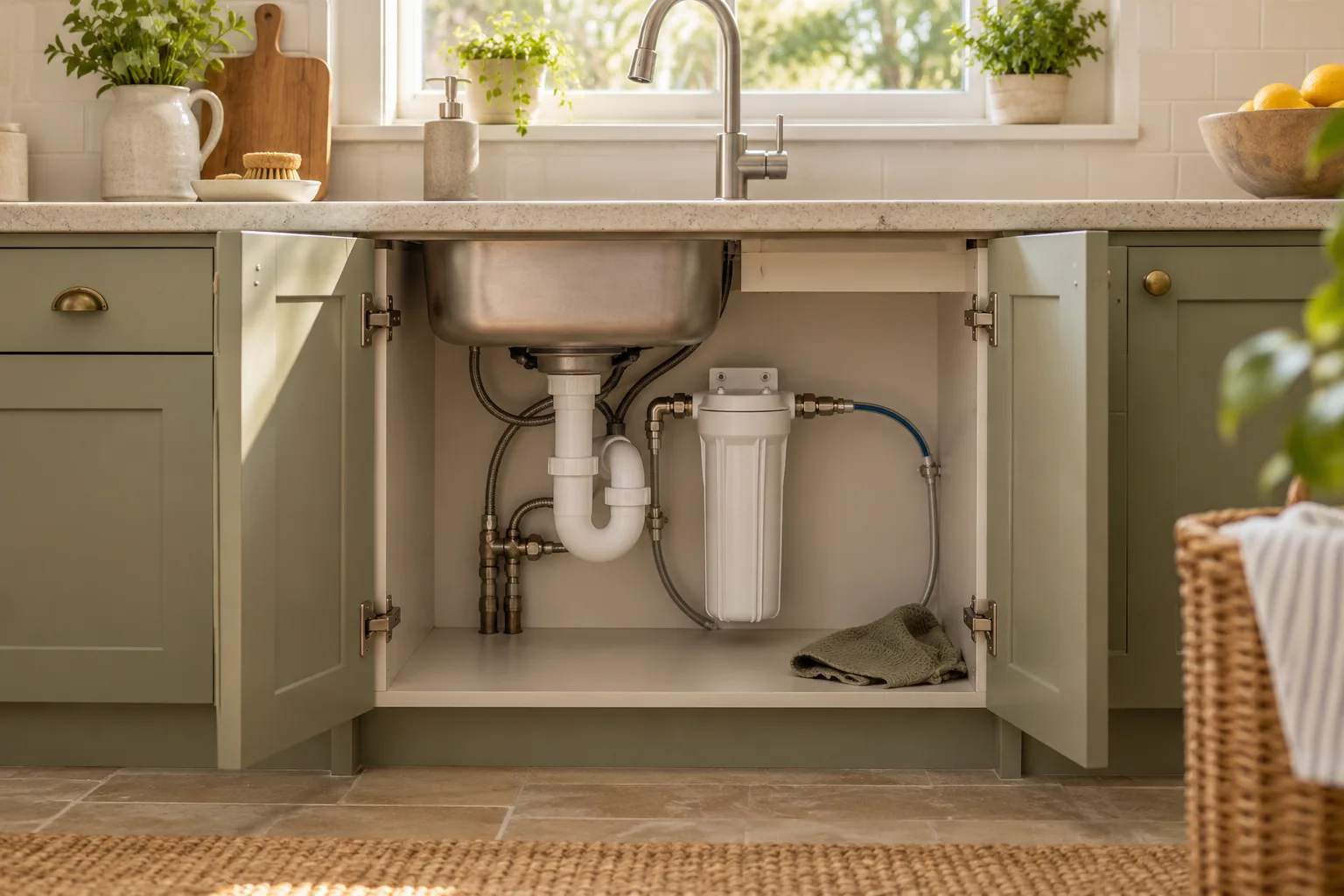
Find whether the problem affects the supply or only filtered water
Start by comparing the ordinary cold-water outlet with the filtered outlet. If both have become weak, the issue may be upstream of the filter or in shared tap components. If only filtered water is affected, investigate that branch. Neither observation alone identifies a failed cartridge, but it narrows the questions before money is spent.
Record whether the system is a passive cartridge arrangement, a direct-connect filter or a pumped RO appliance. Their expected flow, valves, pressure requirements and controls differ. A tankless RO unit’s production and automatic flushing behaviour should not be diagnosed as though it were a simple cartridge feeding the original mixer.
| Symptom | Initial direction | Next useful information |
|---|---|---|
| Ordinary cold and filtered both weak | Supply, shared valve or tap | Other outlets and recent plumbing work |
| Filtered branch alone weak | Head, cartridge, valve and hoses | Model, cartridge code and change history |
| Immediately after replacement | Correct fit and commissioning | Lock position and completed flush |
| RO with fault indication | Exact owner-manual fault procedure | Displayed code and leakage status |
Stop if water is leaking into the cupboard, an electrical component is wet or there is visible damage. Isolate the affected supply where safe and appropriate and obtain help. The checks below are observations around an installed system, not instructions to open a powered enclosure or loosen fittings under pressure.
Revisit the last cartridge change or installation work
If flow fell straight after a change, compare the new cartridge code with the head and system instructions. Check that the appropriate packaging has been removed, the cartridge is fully seated and the head’s lock is in the specified operating position. A new part can still be wrong for the installation.
The BRITA three-way manual identifies incomplete supply or head setup among relevant causes. Check an accessible valve has not been left closed after servicing, without changing an unfamiliar pressure-control setting. Follow the exact isolation and pressure-release sequence before any cartridge removal; do not crack open a connector to see whether water appears.
BRITA P 1000 replacement · 1 cartridge
The compact P-series replacement used by the named BRITA installed-tap systems and compatible head arrangements.
- Capacity / format
- 400–1200L by hardness setting; up to 12 months
- Cartridge / pack
- P 1000
Good forA shorter cartridge and lower-demand supported installation.
Watch forP 1000 is unrelated to MAXTRA PRO jug-cartridge fit.
Select the correct head and hardness settings. Calendar and volume limits apply; the largest capacity figure is not a guarantee in very hard water.
Finish the model’s commissioning flush before judging ordinary use. Trapped air, disturbed tubing and incorrect seating are different from an exhausted cartridge. If the new filter cannot be seated or the symptom remains after the specified procedure, keep the packet and contact the supplier or manufacturer with the complete identity.
Inspect accessible hoses and assess pressure correctly
Look for a hose crushed by a bin, a tight bend behind the cartridge or a valve that was disturbed during other work. Support the system and avoid pulling tubing or using the filter head as a lever. BRITA’s cited manual says kinked hoses must be replaced; simply bending a damaged hose back does not prove its condition is restored.
The actual system must operate within its specified pressure and temperature limits. BRITA’s cited P-series arrangement requires at least 2 bar, whereas the linked G3P600 manual gives 14.5–87psi, approximately 1–6 bar. Those examples demonstrate why one universal pressure target would be misleading.
Arrange a suitable flowing-pressure assessment where needed. A pressure reading with no outlet running is not the same as the available pressure under demand. Do not remove a regulator, increase its setting, add a booster or bypass a treatment stage on the assumption that more pressure is always beneficial.
For a gradual decline, compare service age and actual filtered volume with the cartridge limits. Water conditions can cause early restriction. A larger nominal capacity does not create a pressure boost, and a reminder light cannot rule out a plumbing restriction elsewhere.
For RO, check prefilters and operating faults before buying a membrane
A pumped RO system adds power, a controlled water path and concentrate drainage to the diagnosis. Check the owner manual and displayed fault rather than assuming every weak outlet requires a new membrane. The G3P600 manual lists expired filters, low feed pressure, closed supply, incorrect filter installation and crimped tubing among causes of no output.
Waterdrop G3-N1CF prefilter · 1 pack
The CF pre-sediment/carbon replacement for supported Waterdrop G3, G3P600 and G3P800 systems.
- Stage
- CF prefilter
- Code
- G3-N1CF
- Pack
- 1 cartridge
Good forMaintaining a supported G3-family prefilter
Watch forFollow its own time, volume and water-condition limits.
Confirm G3-N1CF against the exact system. This is one prefilter, not the RO membrane or a complete three-stage refill set.
Its CF stage is a separate prefilter with a shorter nominal replacement interval than the RO membrane. Check which stage is actually due. If it is changed, complete the G3P600 stage-specific reset and flush; resetting an indicator without a replacement does not restore the media.
Waterdrop G3-N3CB carbon filter · 1 pack
The CB activated-carbon replacement for supported G3, G3P600 and G3P800 systems.
- Stage
- CB carbon
- Code
- G3-N3CB
- Pack
- 1 cartridge
Good forMaintaining the supported carbon stage
Watch forA 12-month headline remains subject to volume and conditions.
Check the G3-N3CB code and approved system combination. A carbon-stage change does not renew the membrane or CF prefilter.
Keep the concentrate route unobstructed. A blocked or distorted drain arrangement needs the correct installation check, not an improvised bypass. Lower incoming temperature can also reduce RO production; do not supply hot water to compensate. Repeated pump faults, leakage warnings or wet electrical parts require the manufacturer or an appropriate professional, rather than internal repairs.
Replace a supported failed part or escalate with useful evidence
A direct-connect carbon system has its own cartridge family and supply arrangement. The selected RF10 illustrates a replacement for the supported Waterdrop UA/UB family; it is not the G3 CF stage, an RO membrane or every similarly named ultrafiltration refill. Match the existing code before ordering.
Waterdrop WD-RF10 · 1 pack
One RF10 replacement for the compatible WD-10UA/10UB family. It is a refill, not a complete installation kit.
- Pack
- 1 cartridge
- Family
- WD-RF10
- Fits
- Supported 10UA / 10UB
Good forMaintaining a compatible 10UA system
Watch forConfirm the supplied refill’s time and volume limits.
Confirm RF10 on the existing system. RF10-UF and longer RF15/RF17 names are distinct; do not choose by similar appearance.
Replacement is appropriate when the exact cartridge is due, damaged or confirmed as the cause through the manufacturer’s permitted checks. Do not run an unsupported cartridge-free test, install an unapproved bypass or change the treatment setting just to regain a faster stream. Increased flow is not evidence that the intended treatment remains in place.
For support, provide the system and cartridge codes, whether ordinary cold flow is affected, timing relative to servicing, any fault code and a clear description of accessible hose routing. Add a repeatable timed-fill observation if it can be made without continuing a leak. This helps distinguish a cartridge purchase from a pressure, tap or plumbing repair and keeps the existing installation planning guide focused on future work.
Common questions
Will a larger cartridge fix low inlet pressure?
No. A larger nominal capacity does not provide a pressure boost. The supply must meet the actual system’s requirements.
Why did flow fall immediately after a filter change?
Possible causes include the wrong cartridge, incomplete seating, an open head lock, a closed supply valve, disturbed tubing or an unfinished flush. Check the exact manual before assuming the new media are faulty.
Should I open the filter head while it is pressurised?
Follow the manufacturer’s isolation and pressure-release sequence. Do not loosen connections or remove a housing under pressure as an improvised diagnosis.
Can a kinked tube simply be straightened?
A visibly damaged or sharply kinked hose may need replacement with the specified part. BRITA’s cited manual says kinked hoses must be replaced; do not assume the damage is removed by bending it back.
Does a slow RO outlet always mean the membrane needs replacing?
No. Supply, temperature, prefilters, installation, drainage, power and faults can affect it. Use the system’s indicators and manual before buying a membrane.