
Comparison · Ad
Gravity water filter vs filter jug: space, speed and daily use
Compare ceramic gravity filters and filter jugs by usable storage, counter or fridge space, filtration time, scale reduction and replacement costs.
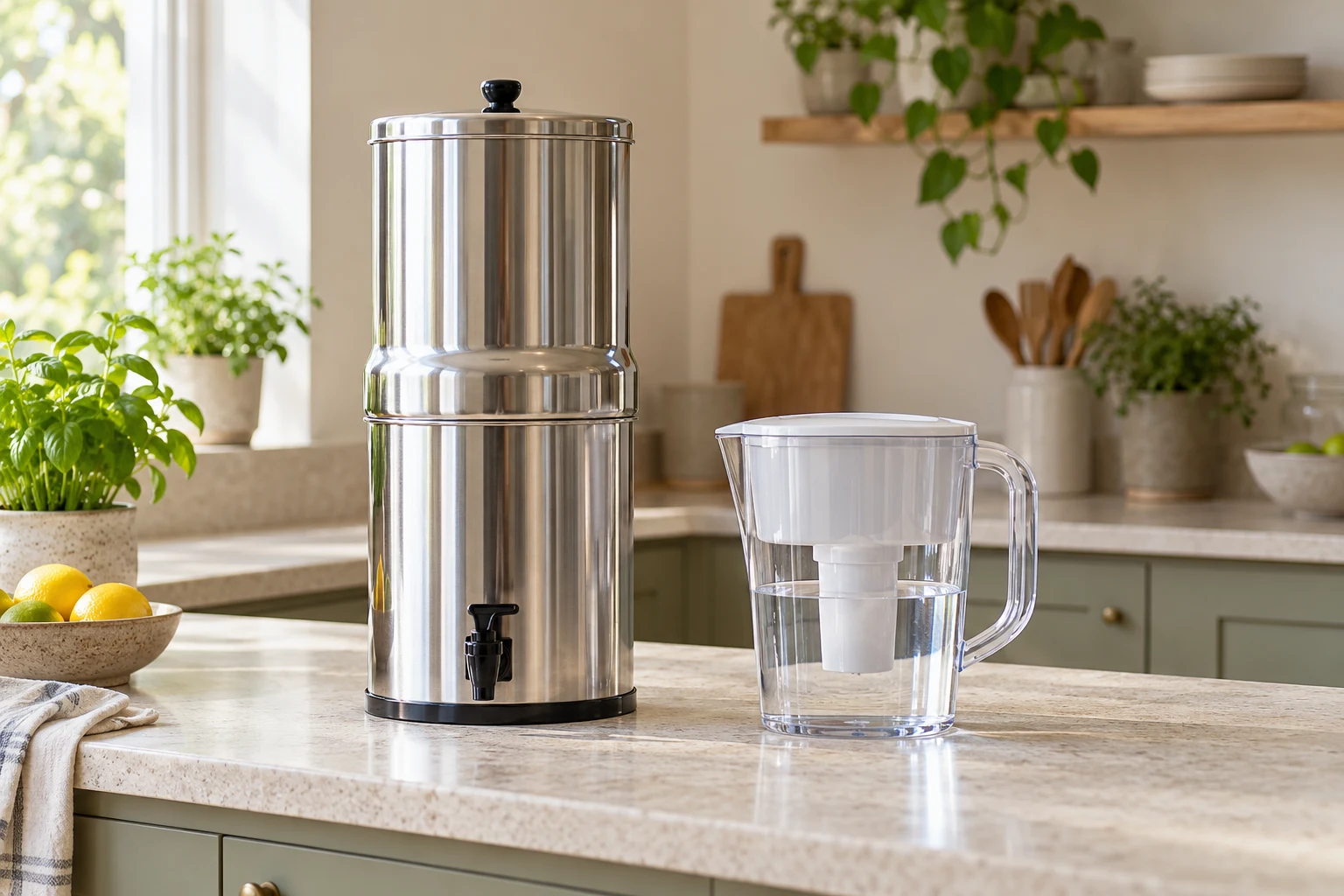
Gravity filter or jug: how do you want to serve water?
Both formats can work without permanent plumbing, but the daily movement is different. A jug is carried to the sink, filled, returned to a shelf and lifted for each pour. A gravity tank normally stays in one location while water is brought to it and glasses are filled from its tap.
Choose the routine that addresses the real inconvenience. If lifting a jug repeatedly is troublesome, a fixed serving point can help. If you want to take chilled water from the fridge to the table, a tall steel dispenser may introduce more work than it removes. A larger container also needs emptying and washing.
This comparison uses a British Berkefeld 8.5L with two Ultra Sterasyl candles and the standard BRITA Marella with MAXTRA PRO as named examples. It is not a claim that every gravity filter or every jug has the same performance, capacity or maintenance routine.
British Berkefeld 8.5L with two Ultra Sterasyl candles
A mid-sized British Berkefeld system with two Ultra Sterasyl candles and 7.8 litres of manufacturer-specified filtered storage.
- Filtered storage
- 7.8L
- Body H / diameter
- 500 / 224mm
Good forShared countertop serving.
Watch forA larger reservoir does not make water filter instantly.
Choose after checking its 500mm body height, 224mm diameter, refill access and the replacement cost of the fitted candle pair.
BRITA Marella 2.4L
A sensible starting point when a fridge-door jug and a widely stocked cartridge family matter more than a large reservoir.
- Filtered / total
- 1.4 / 2.4L
- Depth
- 10.5cm
- Cartridge
- MAXTRA PRO
Good forFridge-door storage and everyday pours.
Watch forTwo large bottles can mean another refill.
Choose it for a small household; its 1.4-litre filtered capacity means more refills when several people pour at once.
Usable storage matters more than the biggest litre label
| Check | British Berkefeld 8.5L | Standard BRITA Marella |
|---|---|---|
| Filtered storage | 7.8L | 1.4L |
| Serving | Stationary tank with tap | Portable pouring jug |
| Body space | 500mm high; 224mm diameter | 258 × 258 × 105mm overall W × H × D |
| Cooling | No active chilling | Can be refrigerated if it fits |
| Refill control | Check lower chamber has room | Follow jug fill and pouring instructions |
Two 750ml bottles need 1.5 litres, slightly above the Marella’s nominal filtered reservoir. A 7.8-litre tank can accommodate more prepared servings, but only after that water has actually filtered. Avoid treating storage capacity as a promise of immediate production.
A gravity tank needs room above the lid and space for a glass below the tap. A stand adds height and must match the vessel. A jug needs clearance around its handle and spout and a route out of the fridge door. Measure the usable space, not just the empty shelf dimensions shown in an appliance brochure.
Account for full weight and cleaning access. Water adds approximately one kilogram per litre before the container and fittings. A tank that is comfortable while empty may be awkward to move after filling. Keep the complete base supported and empty the vessel before maintenance.
Separate filtration speed from the speed of a pour
A full lower reservoir can dispense a glass quickly even though filling that reservoir took hours. Conversely, an empty gravity tank cannot instantly provide water just because its tap has a wide outlet. A replacement tap changes serving behaviour, not the treatment rate through the candles.
Doulton describes roughly one litre per hour per conditioned candle as a guide. Water level, saturation and surface deposits affect the actual rate. Two installed candles do not guarantee two litres per hour under all household conditions. See slow gravity-filter checks if the rate changes.
New ceramic candles may take two or three chamber fills to become fully saturated. Their preparation includes discarded water, so do not plan the first assembly immediately before guests arrive. A jug cartridge has its own preparation sequence and cannot be used as the timing reference for ceramic candles.
Manage refilling carefully. Empty upper-chamber space does not mean the lower tank has matching space. Continued top-ups can overflow the bottom reservoir. Keep track of what has been dispensed and what remains above, rather than assuming a float valve or automatic shutoff is present.
Choose the media for taste, scale or a named reduction claim
Ultra Sterasyl combines a ceramic outer with internal treatment media. MAXTRA PRO is a different carbon-and-ion-exchange cartridge route. These are not interchangeable just because both can improve aspects of water taste. Compare the exact product and the concern you want to address.
For kettle scale, use a cartridge explicitly positioned and documented for limescale reduction. Do not assume the gravity candles in this comparison act as softeners. Retaining dissolved minerals and achieving a low TDS reading are also different objectives; a meter display is not a universal score for either system.
If fluoride reduction is the defined objective, British Berkefeld has an Ultra Fluoride grade with separate evidence. It must not be mixed with Ultra Sterasyl in the same installation. Read the candle comparison before changing an existing setup.
Both choices must be used with the water and conditions in their instructions. The steel system’s portability is not permission to filter an untreated stream or an unknown supply. Supplier incident advice and adequate source assessment take priority over a household product comparison.
Compare a complete change and the work between changes
A two-candle gravity system needs two replacement candles at each complete change. At the recommended six-month interval that is four candles per year, before any earlier limit. MAXTRA PRO uses an up-to-150-litre or four-week instruction, so a low-use household may reach the time limit roughly thirteen times per year.
British Berkefeld Ultra Sterasyl 8674, two-pack
Two British Berkefeld Ultra Sterasyl ceramic gravity candles, with the documented 8674 identity; a replacement pair for a correctly matched system.
- Identity
- 8674 / W9121226
- Pack
- 2 gravity candles
Good forReplacing a confirmed Ultra Sterasyl pair.
Watch forNot Biotect Ultra; do not mix with Ultra Fluoride.
Choose for the confirmed gravity housing and same-grade configuration. Cleaning may restore flow but does not reset the replacement schedule.
BRITA MAXTRA PRO Pure Performance · 6 pack
The everyday-purpose MAXTRA PRO replacement for compatible BRITA jugs and Flow. Compare this six-pack with the cartridges already included in your chosen starter bundle.
- Pack
- 6 cartridges
- Family
- MAXTRA PRO
- Limit
- 150L / 4 weeks
Good forRestocking a compatible MAXTRA PRO system.
Watch forFour weeks can arrive long before 150 litres.
Check the MAXTRA PRO family against your jug instructions. It is not a replacement for BRITA Classic, MicroDisc or ON TAP cartridges.
Different counts do not establish which annual bill is lower. Divide the correct pack price by its contents, then multiply by the replacement demand for that configuration. Include the initial vessel, supplied media, any necessary stand and any earlier changes. Keep illustrative arithmetic separate from live prices.
Ceramic surface cleaning adds a maintenance task but does not regenerate the internal media. Jug cleaning involves its own body, lid and indicator restrictions. Choose the format you will maintain consistently; use our gravity shortlist or jug starting point once the daily routine is clear.
Common questions
Does a gravity filter hold more ready water than a jug?
The named 8.5L British Berkefeld has 7.8L filtered storage, compared with 1.4L for the standard Marella. Other models differ, so compare filtered capacity rather than total labels.
Is a gravity filter faster than a jug?
Not generally on the evidence used here. Ceramic gravity filtration is a slower batch process; Doulton gives about 1L per hour per conditioned candle as an approximate guide, affected by conditions.
Which is better for kettle limescale?
Choose a cartridge specifically documented for that objective. Do not assume the ceramic candles discussed here soften water merely because they improve taste or reduce particles.
Can a gravity system chill its water?
No. The countertop systems discussed here have no active cooling. A fridge-fitting jug is usually the more practical route to a small refrigerated supply.
Does cleaning a ceramic candle eliminate replacement costs?
No. Cleaning can restore surface flow within its service life. Internal media still has capacity and time limits, and each installed candle needs its appropriate replacement.
Sources and further reading
- British Berkefeld: system sizes, filtered capacities and candle exclusions
- BRITA UK: Marella filtered capacity and dimensions
- Doulton: gravity-filter conditioning, water level, approximate flow and overfill prevention
- British Berkefeld: stainless-steel gravity system operating and cleaning instructions
- Drinking Water Inspectorate: domestic filters and softeners