
Maintenance guide · Ad
How to clean a countertop RO water tank and manage leftover reject water
Separate feed water, treated storage and concentrate; follow C1H and K19-HG tank care, discard flush water, and match replacement filters before restarting.
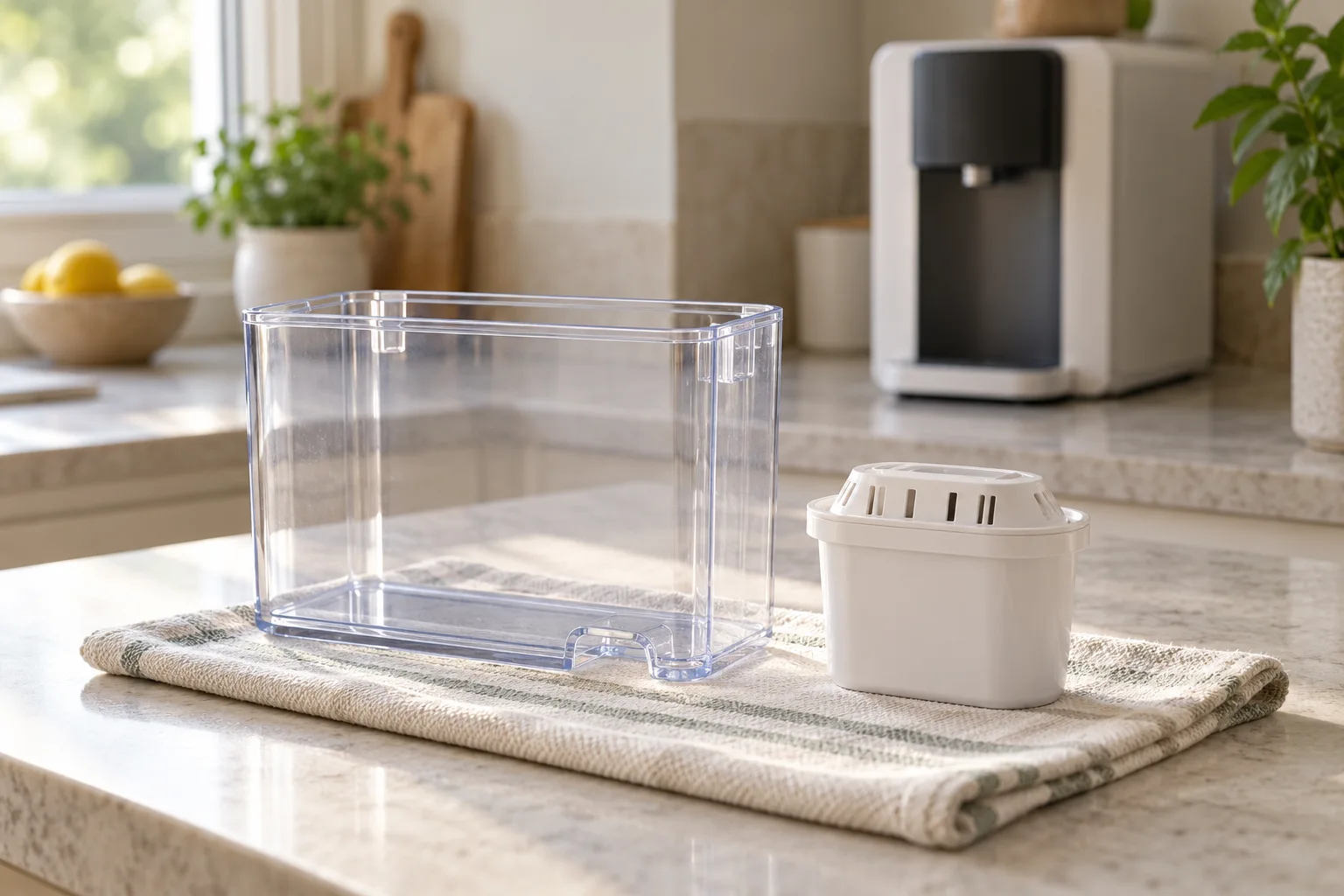
Identify feed water, treated storage and concentrate
A refillable countertop RO appliance contains several kinds of water during normal use. Fresh tap water enters the feed tank. The membrane produces a treated stream for drinking-water storage and leaves a more concentrated stream behind. Startup and maintenance programmes also create flushing discharge. Those streams must not be treated as interchangeable because they look equally clear.
In the C1H and K19-HG arrangements discussed here, the remaining feed water must be emptied before a fresh fill as the manual directs. A refill warning can therefore appear while there is still visible water. It is not an instruction to keep that remainder and add another jugful on top.
| Water | Where it belongs | Action |
|---|---|---|
| Fresh feed | Specified feed tank | Use suitable cold municipal tap water |
| Remaining concentrate | Left in feed arrangement after treatment | Empty before refilling; do not recirculate |
| Treated water | Designated pure-water vessel or reservoir | Keep fresh and clean the storage path |
| Flush / cleaning discharge | Collection jug or prescribed drain route | Discard; not a drinking-water batch |
The manufacturer’s model name and manual revision matter. A2 has a different tank and control arrangement, and an under-sink RO system normally has a fixed concentrate drain. Do not copy a refillable appliance’s tank-removal steps onto a plumbed unit.
Empty the remainder and keep the feed tank fresh
Stop dispensing before handling removable tanks, allow hot parts to cool and follow the manual’s power instructions. Remove the feed vessel using its designed handle, pour away the remainder and refill with fresh water within the stated source limits. Do not exceed the maximum line or wet the appliance’s electrical connection while carrying or refitting it.
Waterdrop C1H hot countertop RO
A compact refillable RO appliance for a smaller worktop, with heating and a separate removable one-litre pure-water tank.
- Capacity / pack
- 3.2L feed · 1L pure tank
- System / cartridge
- C1RF
Good forCompact footprint and heated filtered water.
Watch forA feed-tank fill is not the same volume of ready drinking water.
Choose it when avoiding fixed plumbing matters and you can empty the concentrate, refill and clean the tanks regularly. It has no built-in chiller.
The C1H UK/EU manual calls for feed-tank cleaning during daily water replacement, including the floating ball and filter screen. It describes changing water in the feed and pure-water tanks after more than two days without use. This means refreshing their contents, not purchasing replacement plastic tanks. Use the complete restart and flushing instructions where required.
The K19-HG UK manual recommends a daily water change and strongly recommends weekly manual cleaning of the feed tank, float, silicone cover and screen. It also says to discard remaining tank water after at least three days without use. These intervals differ from C1H wording, so record the routine for your actual model rather than selecting the longest interval from another machine.
Keep clean pure-water parts away from a dirty sink, used washing cloths and the concentrated feed remainder. A pure-water tank should not become the collection jug for descaling waste. Wipe up spills promptly and refit each vessel only in its intended location.
Clean small parts without turning tank care into a chemical flush
The C1H and K19-HG manuals show removable float and screen parts in the feed tank. Refer to the diagrams before removing them, keep the small pieces together and reinstall the float, silicone cover and screen fully. A misplaced float can cause an operating problem that a new membrane will not solve.
Their cited maintenance instructions describe a monthly 30-minute removable feed-tank soak with citric acid or an appropriate descaling agent. This is a tank-care instruction. It is not permission to circulate acid through the RO membrane, pure-water reservoir, heater or chiller. The cited passages do not provide a universal concentration; obtain the model-specific approved dose rather than borrowing an Aurora recipe.
Rinse cleaned removable parts thoroughly as directed before refilling and returning them to service. Do not assume dishwasher approval, use abrasive pads or clean the membrane itself with household chemicals. The K19-HG instructions prohibit steel wool, abrasive cleaners and organic solvents such as alcohol; C1H similarly warns against harsh chemicals and abrasives.
Clean the drip tray as a separate weekly task in these manuals. It can collect old water even while the feed tank looks clean. Keep the electrical body out of washing water and do not dismantle the powered enclosure to reach internal components. Persistent contamination, damage or odour needs manufacturer advice rather than an improvised stronger soak.
Match the cartridge and finish the complete flush
The C1H replacement is C1RF. K19-HG uses K19RFG, and the selected A2 uses A2RF. The shared Waterdrop name and similar cylindrical photographs do not establish cross-compatibility. Check the complete code on the old filter, appliance label and current manual before opening a replacement pack.
Waterdrop C1RF replacement · 1 pack
The exact C1RF replacement family named for the selected Waterdrop C1H countertop reverse-osmosis system.
- Capacity / pack
- One replacement cartridge
- System / cartridge
- C1RF
Good forMaintaining the selected C1H system.
Watch forComplete the specified flush after fitting; a new filter is not ready straight from its wrapper.
Buy by the C1RF code rather than the shared CoreRO name. C1RFG mineralising filters are a different listing and should not be assumed equivalent.
Waterdrop K19RFG mineral replacement · 1 pack
The mineralising K19RFG cartridge identified for the Waterdrop K19-HG countertop reverse-osmosis appliance.
- Capacity / pack
- One mineralising replacement
- System / cartridge
- K19RFG
Good forKeeping the K19-HG replacement specification.
Watch forMineral addition can raise conductivity; a non-zero TDS reading is not proof of failure.
Check every letter on the existing cartridge and appliance label before ordering. The selected K19RFG is not the similarly named K19RF legacy replacement.
Waterdrop A2RF replacement · 1 pack
The A2RF RO cartridge supplied as the named replacement for the selected Waterdrop A2 hot-and-cold system.
- Capacity / pack
- One replacement cartridge
- System / cartridge
- A2RF
Good forMaintaining the selected A2 system.
Watch forFollow the A2 manual flush and reset sequence after replacement.
Choose this listing for the A2 model after checking the filter code. Do not transfer A1, A2G or C1-family compatibility from a similar product photograph.
Fit and reset using the exact model sequence, then complete its flushing programme with fresh feed water. C1H’s UK/EU instructions explicitly say not to drink the water dispensed during flushing and not to reuse collected flush water. At a water-change prompt, empty the remainder before refilling; waiting for the display to progress does not remove that step.
A low TDS reading does not prove hygienic storage or successful chemical rinsing. Mineralising cartridges can also raise conductivity intentionally. Use the TDS explanation to keep that display in perspective, and continue normal cleaning and calendar replacement even when the number looks reassuring.
Manage concentrate and longer periods without use
Dispose of ordinary remaining feed water by the manufacturer’s prescribed route; pouring it away is the straightforward household default. Do not use it for drinking, cooking or refilling the purifier, and do not assume it suits every plant or household task. Its composition depends on the incoming water and concentration. Water containing cleaning chemicals is a separate waste stream and must be handled according to the product instructions.
A stated 3:1 treated-to-concentrate ratio describes three parts treated water plus one part concentrate under the specified conditions. That is 75% theoretical recovery before additional flushing, not a guarantee that every four-litre fill yields three litres in everyday use. Keep the initial flush and repeated cleaning water in any ownership estimate.
Before a holiday, follow the exact drain and storage instructions. K19-HG’s manual separately describes emptying the internal pure-water tank after more than a week without use; emptying only the removable feed tank is not the same task. On return, inspect, refresh, clean and complete the required flush before drinking. For broader appliance choices, compare countertop and under-sink RO ownership.
For an installed G3P600, use its separate CF, CB and RO replacement procedure. Mineral-adding cartridges also need an exact system match; a countertop replacement is not a universal inline add-on.
Common questions
Why is there water left when the refill warning appears?
It can be concentrated feed water, not a spare quantity to keep topping up. The C1H and K19-HG instructions say to empty the remainder before adding fresh water.
Can reject water go back through the RO machine?
Do not recirculate it into the feed tank. That undermines the intended fresh-water refill and can increase the concentration presented to the membrane.
Is flushing water ready to drink?
The C1H manual says not to drink water dispensed during flushing and not to reuse collected flush water. Complete the full programme with fresh feed water.
Can I pour citric acid into the machine to clean everything?
No. A model-specific removable feed-tank soak is not permission to circulate chemicals through the membrane, pure tank, heater or chiller. Check the prescribed location and method.
Does a low TDS reading prove the tanks are clean?
No. Conductivity is not a hygiene test. Cleanliness, replacement intervals, fresh water and the prescribed restart programme remain necessary.