
Buying advice · Ad
RO remineralisation cartridges: what they change, compatibility and replacement costs
Understand optional post-RO mineral stages, proprietary mineralising replacements, tubing and system compatibility, TDS changes and realistic replacement costs.
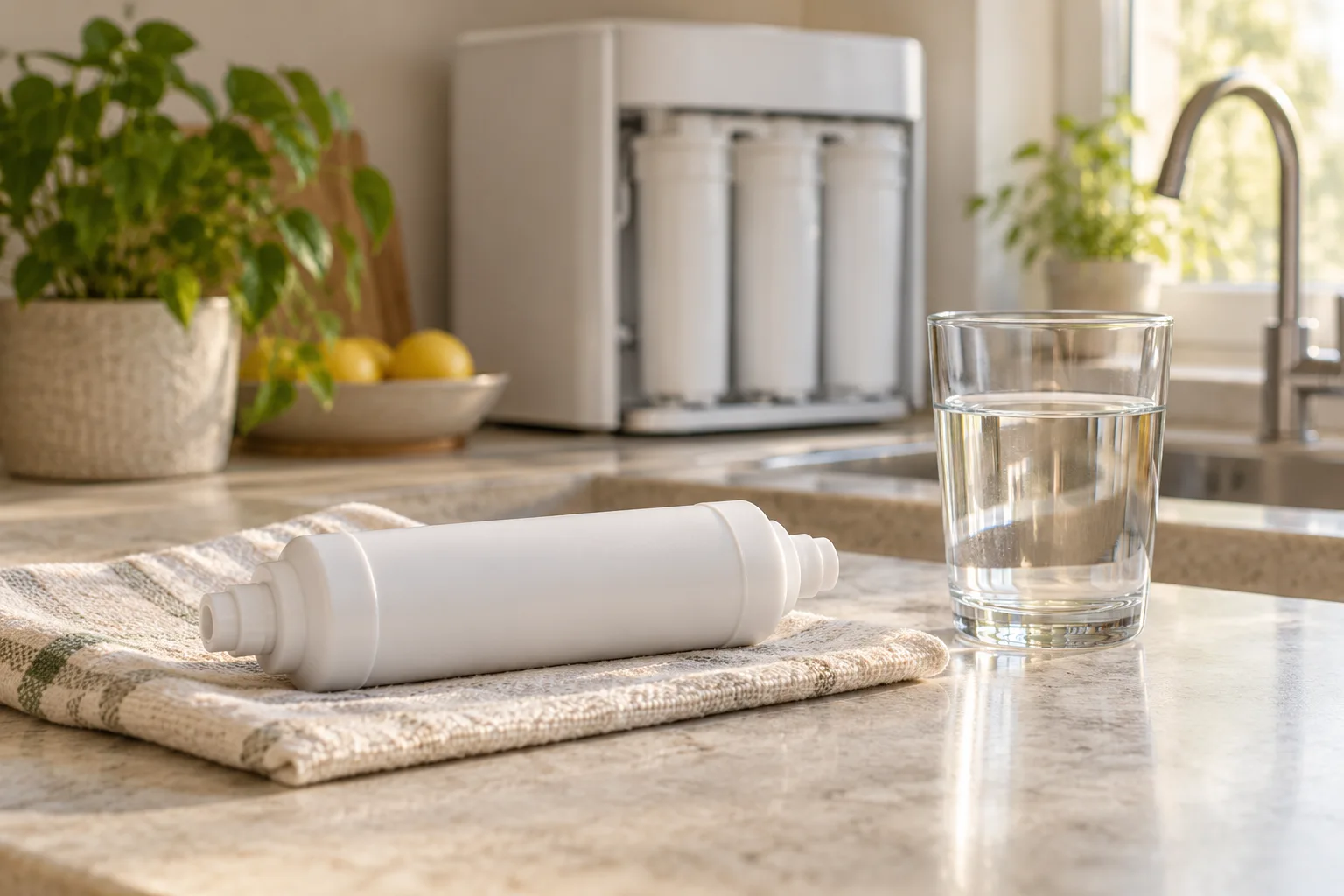
Mineral addition is separate from the RO membrane’s job
A reverse-osmosis membrane reduces a range of dissolved substances under its specified conditions. A remineralisation stage comes afterwards in an approved arrangement and adds selected mineral material back to the treated water. It can change taste, conductivity and pH, but it does not replace the membrane or repeat every upstream treatment function.
Treat the decision as an optional system and taste choice, not a universal health requirement. A cartridge described as alkaline does not demonstrate that drinking its output prevents disease or provides a dependable nutritional dose. Check the actual media, conditions and compatibility rather than buying on a broad wellness claim.
Mineral addition can raise a TDS reading because dissolved ions affect conductivity. That is not automatically a sign of membrane failure, and the number does not identify individual minerals or prove hygienic storage. Our TDS explanation separates those questions from what a conductivity meter can measure.
Distinguish inline post-treatment from a proprietary mineralising cartridge
An inline cartridge is a separate component fitted into a supported water path. The iSpring FA15 example has a quarter-inch fitting and a published six-month or 1500-US-gallon service limit, whichever comes first. Confirm the supplied connection and full system approval before treating it as an add-on to an existing appliance.
iSpring FA15 inline mineral cartridge
A closed inline mineral cartridge intended to add a post-treatment stage to a compatible RO arrangement.
- Capacity / format
- Six months or 1500 US gallons
- Cartridge / pack
- FA15 · 1/4-inch fitting
Good forA manufacturer-approved inline mineral stage.
Watch forNot a contaminant-removal membrane or a replacement for primary RO treatment.
Confirm tubing, fitting type, flow direction, pressure and installation position with the system manufacturer. Matching tube diameter alone does not approve a retrofit.
Waterdrop’s MNR35 is another documented inline example, with a different nominal twelve-month or 1100-gallon schedule and named supported systems. That is a manufacturer specification to compare, not a universal approval for every RO unit. Do not transfer its schedule or fitting instructions to FA15 simply because both products are described as mineral filters.
Waterdrop K19RFG mineral replacement · 1 pack
The mineralising K19RFG cartridge identified for the Waterdrop K19-HG countertop reverse-osmosis appliance.
- Capacity / pack
- One mineralising replacement
- System / cartridge
- K19RFG
Good forKeeping the K19-HG replacement specification.
Watch forMineral addition can raise conductivity; a non-zero TDS reading is not proof of failure.
Check every letter on the existing cartridge and appliance label before ordering. The selected K19RFG is not the similarly named K19RF legacy replacement.
K19RFG is a different format: the proprietary mineralising replacement named for K19-HG. It is not a loose inline accessory that can be attached to an arbitrary under-sink system. The complete filter code and supported appliance matter more than a shared claim to add minerals. The countertop RO guide explains that appliance family.
| Example | Format | What to verify |
|---|---|---|
| iSpring FA15 | Separate inline mineral cartridge | Approved post-RO position and connection |
| Waterdrop MNR35 | Separate inline mineral cartridge | Named system and own replacement limits |
| Waterdrop K19RFG | Proprietary mineralising replacement | Exact K19-HG appliance match |
| G3P600-RO | RO membrane replacement | Primary membrane stage, not mineral addition |
A quarter-inch connection is only one compatibility check
Confirm the tube’s outside diameter, connector design and supplied end fittings. Nominal quarter-inch tubing is not an instruction to force any approximately similar hose into a connector. A fitting can appear to hold while being incorrectly seated or unsuitable for the pressure, material or installation environment.
The system manufacturer should approve the stage’s position relative to the membrane, any storage tank, final carbon stage, valves and dispensing tap. Check the flow-direction marking and the complete operating limits, including pressure and temperature. Do not copy a diagram from a different brand or assume all post-treatment arrangements are equivalent.
Leave room to support the cartridge and replace it without straining tubing. Check that existing brackets, leak detection, shutoff and any appliance access remain functional. An add-on that makes an isolation valve inaccessible or encourages an unsupported bend creates a maintenance problem even if the water initially flows.
Have plumbing changes assessed by an appropriate installer and confirm any effect on the system’s approvals and warranty. A generic cartridge cannot inherit the complete original system’s certification simply by being connected after it. Keep this separate from selecting a genuine replacement for a component the manufacturer already specifies.
Budget from the exact schedule and the whole treatment chain
The cited FA15 specification uses six months or 1500 US gallons, whichever arrives first. That gallon figure is a US measure, not 1500 litres or UK gallons. At modest household use, the calendar limit may be reached long before the headline volume, so dividing price by maximum litres alone can understate the practical cost.
For a simple illustration, a hypothetical £30 cartridge changed on a six-month schedule represents £60 for two cartridge periods per year. A hypothetical £30 cartridge with a twelve-month schedule represents £30 per year for that stage. These are arithmetic examples, not current prices or a ranking of different products’ treatment performance.
Waterdrop G3P600-RO membrane · 1 pack
The named RO replacement membrane for the G3P600 system, distinct from the older G3 membrane.
- Stage
- RO membrane
- Code
- G3P600-RO
- Pack
- 1 cartridge
Good forReplacing a supported G3P600 membrane
Watch forThe 24-month maximum does not apply to CF or CB filters.
Use with the approved G3P600 system. The matching model and membrane appear in IAPMO listing WC-13976; exact certified claims and conditions still matter.
The membrane, prefilters and any final carbon stage keep their own schedules. Adding a mineral cartridge does not renew them or allow their indicators to be reset. Include delivery, approved fittings, installation and commissioning water when comparing the full ownership cost, using the running-cost resource for the arithmetic where applicable.
Avoid buying a large stock of speculative replacements before compatibility is established. A proprietary countertop cartridge and an inline under-sink stage may have similar annual prices while requiring entirely different equipment. Price is useful only after the correct treatment path and service limits have been identified.
Check operation without mistaking a display for a laboratory result
After an approved installation or replacement, complete the exact cartridge’s commissioning flush, inspect the supported connections for leakage and confirm ordinary dispensing. Do not use a generic flush duration borrowed from the RO membrane or a different mineral cartridge. Retain the code, installation record and applicable replacement reminder.
The location of the TDS sensor matters. A display upstream of an added mineral stage may not show the water after mineral addition; a separate downstream reading answers a different question. Compare readings at consistent points and conditions before interpreting a change. Neither reading verifies the amount of calcium, magnesium or another individual substance.
If the concern is a named contaminant, retain the original treatment and verify the exact system claim using the certification guide. If the concern is an installation fault, use the under-sink troubleshooting guide. Mineral addition is a distinct choice and should not distract from correct filtration, fresh water and maintenance.
Common questions
Is remineralisation essential for every RO owner?
It is a separate treatment preference and system-design choice. Do not assume every household needs an add-on or that a particular cartridge is medically necessary.
Will the TDS reading rise after a mineral cartridge?
It can, because added dissolved minerals increase conductivity. That change alone is not proof of membrane failure, hygiene or the amount of any individual mineral.
Does a quarter-inch fitting make it universally compatible?
No. Check tube outside diameter, connector type, pressure, flow, location, valve arrangement and the system manufacturer’s approval as well as the nominal size.
Can K19RFG be used as an inline under-sink cartridge?
No universal interchangeability should be inferred. K19RFG is the named proprietary mineralising replacement for K19-HG, while an inline post-treatment cartridge has a different installation format.
What replacement interval should I budget for?
Use the exact product limit. The cited FA15 specification gives six months or 1500 US gallons, whichever comes first; other mineral cartridges can have different schedules.
Sources and further reading
- iSpring: FA15 inline mineral cartridge, quarter-inch fitting and six-month/1500-gallon life
- Waterdrop UK: MNR35 post-treatment mineral stage and named systems
- Waterdrop UK: K19-HG and its integrated mineralising K19RFG cartridge
- Waterdrop: G3P600 owner manual, replacement, seven-second resets and separate flush routines
- Drinking Water Inspectorate: drinking-water quality and consumer guidance