
Compatibility guide · Ad
ZeroWater cartridge compatibility: legacy filters vs newer Culligan systems
Identify legacy screw-in ZeroWater filters and newer Culligan drop-in cartridges. Check the connection, exact replacement pack and meter instructions.
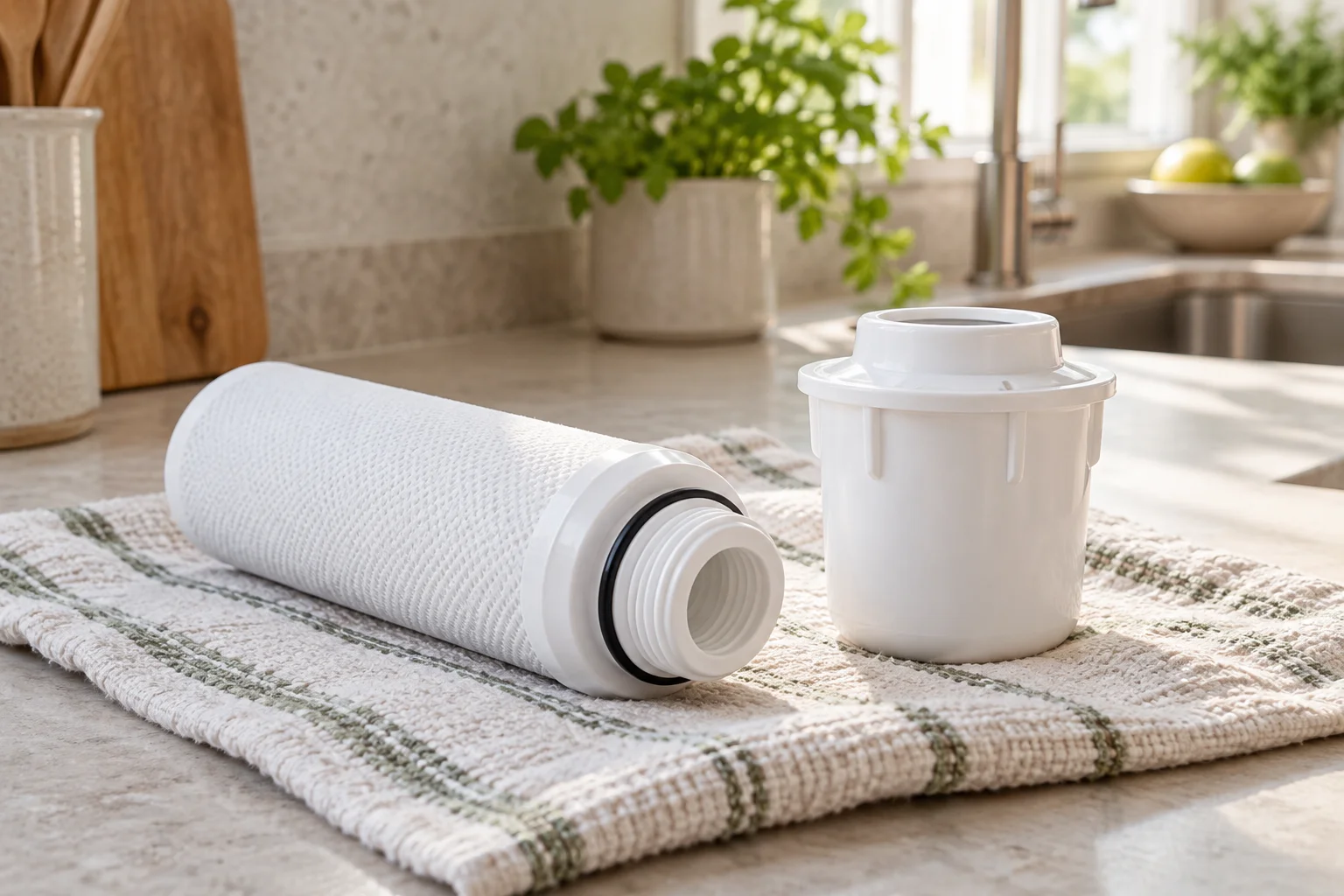
Identify the connection before ordering a ZeroWater replacement
The older advice that one ZeroWater cartridge fits every ZeroWater jug is no longer a safe shopping rule. Culligan’s compatibility guide separates legacy ZeroWater from newer Culligan with ZeroWater Technology devices. Their filters have different connections, so similar names and five-stage descriptions cannot establish fit.
Remove the upper reservoir only as your device manual instructs, with water emptied first. Look at where the old cartridge connects. A legacy cartridge attaches by screwing into the underside of the upper reservoir. A newer cartridge is installed downwards from above. Do not dismantle the cartridge to identify it: inspect its external attachment and the vessel’s seat.
| Clue | Legacy ZeroWater | Newer Culligan ZeroWater |
|---|---|---|
| Installation | Screws into reservoir from underneath | Drops into upper reservoir from above |
| Typical branding | ZeroWater | Culligan with ZeroWater Technology |
| Typical refill lid | Removable lid | Sliding refill lid |
| Cross-fit | Not compatible with newer drop-in | Not compatible with legacy threaded |
Branding and lid design are supporting clues from the manufacturer, not substitutes for examining the connection. Replacement lids, retailer photography and changing packaging can make visual identification less straightforward. If the body or cartridge is missing, find the device code or obtain confirmation from manufacturer support before ordering.
Choose the exact replacement family
For a threaded legacy device, use a replacement explicitly identified for legacy screw-in ZeroWater jugs and dispensers. The linked four-pack is a relevant example. Its retail title uses the Culligan name, which shows why that word alone cannot be used as a generation test.
Legacy ZeroWater screw-in filters, four-pack
Four replacement filters for the legacy screw-in ZeroWater connection, whose life depends on incoming water and use.
- Pack
- 4 cartridges
- Connection
- Legacy threaded
Good forMaintaining a confirmed legacy ZeroWater vessel.
Watch forNot compatible with newer drop-in systems.
Match the threaded reservoir connection before ordering; Culligan in a retail title does not identify the newer drop-in format.
For a newer top-down device, use the newer Culligan with ZeroWater Technology drop-in pack. The three-pack below belongs to that family. It is not an upgrade cartridge for an older reservoir and should not be bought in the hope that a seal can be adapted.
Culligan with ZeroWater Technology drop-in filters, three-pack
Three replacements for the newer Culligan with ZeroWater Technology drop-in system; they do not fit legacy screw-in devices.
- Pack
- 3 cartridges
- Connection
- Top-down drop-in
Good forMaintaining a confirmed newer Culligan device.
Watch forNot compatible with legacy screw-in systems.
Choose only after checking the top-down connection in the jug or dispenser and the exact selected pack.
Do not force, trim or add improvised gaskets to a mismatched cartridge. A filter resting in the hopper is not necessarily sealed into the intended water path. Apparent flow can be bypass flow around a badly matched fitting, so a fit claim needs more than a photograph of a cartridge inside a jug.
Culligan also lists MaxClear gravity filters separately. Those are not a third interchangeable ZeroWater jug option. Keep countertop gravity-system elements, legacy screw-in cartridges and newer drop-in replacements in separate shopping lists. See the broader cartridge compatibility directory for other brand-family distinctions.
Read selected options and performance evidence separately
A marketplace product page may group pack sizes, older packaging and several sellers. Check the selected option after following a link: cartridge count, connection image, family wording and delivered price must all describe the same purchase. A headline suggesting one filter is not enough if the actual selected pack differs.
Be especially careful with listings that use “new”, “advanced” or “compatible” without naming the connection. Ask a specific question: “Does this pack fit the legacy cartridge that screws into the underside of the upper reservoir?” That produces a more useful answer than “Does this fit ZeroWater?”
Physical fit and certified performance are separate matters. A report for a newly designed cartridge does not automatically describe the legacy filter. Match the exact system and cartridge in the manufacturer’s current performance document or certification listing. Do not combine the strongest claims from both generations into one product description.
A TDS meter cannot independently prove removal of lead, PFAS or bacteria. Its role here is operational monitoring of a deionising filter. For a substance-specific concern, follow our verification guide and the relevant public-water advice rather than inferring a health outcome from a low number.
Fit according to the correct generation’s manual
Once the pack is confirmed, clean the vessel as directed and follow its own installation instructions. A legacy threaded filter needs the correct seated connection; a drop-in system has a different fitting procedure. Do not apply the twist direction, seal arrangement or priming routine from another brand merely because both cartridges are white cylinders.
Check for damage, packaging problems or a missing seal before using a new cartridge. If the part will not seat as shown in the manual, stop and compare the model information. Excessive force is not a sensible compatibility test. Keep an unopened replacement pack sealed while checking an uncertain fit where possible.
Culligan’s operational guidance uses a TDS reading of 6 ppm or higher as a replacement trigger. Follow the sampling procedure for your meter and device, using a clean vessel and avoiding contamination of the sample. Do not keep using a cartridge past the prescribed trigger because its water still looks clear or the new pack has not arrived.
Lifetime varies with feed water and consumption. A multipack does not establish a fixed number of months, and a larger dispenser does not give the cartridge a larger treatment capacity. For budgeting, record the actual volume between changes and compare the correct-generation pack price per filter.
Keep a simple compatibility record for the next purchase
Photograph the device label, cartridge connection and unopened correct pack. Save the full replacement description and your device’s manual together. This small record is useful when a marketplace title changes or a family’s packaging is refreshed.
For a household with both generations, label the spare packs clearly and avoid moving an already used filter between vessels. Different connections are one reason; maintaining a predictable cleaning and replacement history is another. Use the selected product’s care instructions for storage and any prolonged break in use.
When choosing a replacement vessel, decide whether retaining your spare legacy cartridges matters. A newer Culligan jug needs its own replacement family. Our ZeroWater jug and dispenser guide explains size and storage choices; our BRITA comparison covers the different filtration and cost objectives.
Common questions
Will a new Culligan ZeroWater filter fit my old ZeroWater jug?
No. The newer top-down drop-in design is incompatible with legacy bottom-threaded ZeroWater jugs and dispensers.
Does the word Culligan on an Amazon title mean drop-in?
No. Retail titles for legacy cartridges can also use Culligan. Identify the physical installation type and the exact selected product.
Can I use a legacy filter in a new Culligan jug?
No. Compatibility does not work in the reverse direction either. Buy the drop-in family specified for the newer device.
Are MaxClear gravity filters ZeroWater jug replacements?
No. Culligan presents MaxClear as a separate gravity-filter family. A shared parent brand does not establish a jug-cartridge fit.
Does 006 ppm mean my tap water is unsafe?
No. Six ppm is the manufacturer’s replacement trigger for these filter systems. A conductivity-derived TDS reading does not assess overall drinking-water safety.