
Comparison · Ad
Filtered hot-water dispenser vs kettle: convenience, temperature and electricity costs
Compare dispenser and kettle energy costs with 27 calculation scenarios, background-power budgets, portion sizes and transparent formulas using published physics sources.
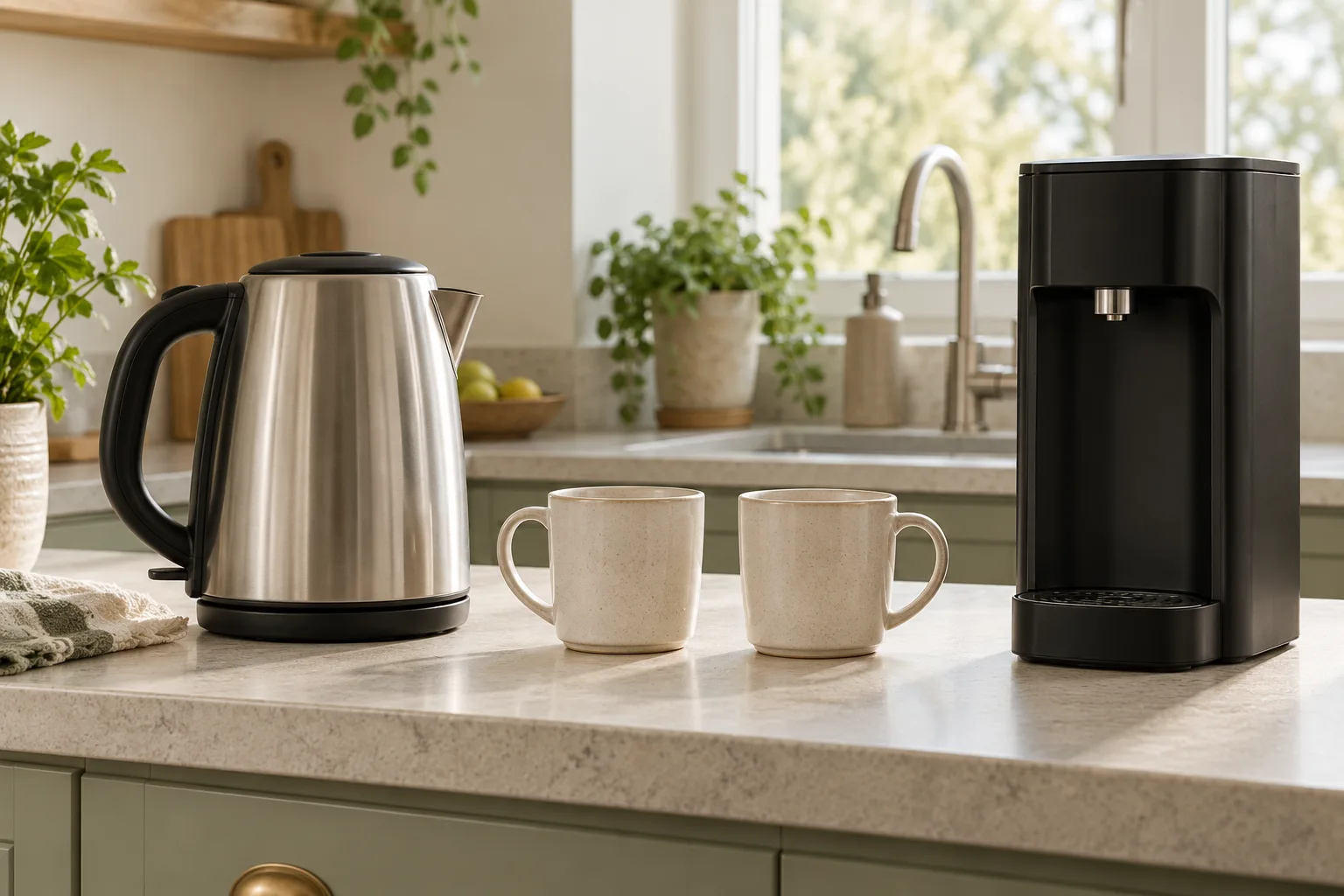
Compare the jobs you need the appliance to do
A filtered hot-water dispenser can make repeated drinks convenient by combining cartridge filtration, selected temperatures and measured portions. A kettle provides a familiar way to heat a batch, including a rolling boil when used as instructed. Neither arrangement is automatically cheaper, cleaner or more suitable for every household.
Begin with a normal day. Count the number and size of drinks, whether they are made together or separately, and the temperatures actually needed. Then add cooking uses. An appliance that works well for one 250ml mug may be less convenient for filling a large pan, while a kettle’s minimum-fill mark may require heating more water than one small drink uses.
The original BRITA Cube has ambient-to-95°C settings and portions up to 450ml. The selected Aurora hot-and-cold model adds a chilled reserve and different volume choices. These are examples of different functions, not interchangeable versions of a single product type.
BRITA Cube 4L hot-and-ambient dispenser · white
The original four-litre Cube provides ambient water and four heated presets, using the MAXTRA PRO cartridge family.
- Capacity / pack
- 4L tank · no built-in chilling
- System / cartridge
- MAXTRA PRO; Limescale Expert recommended
Good forAmbient, 45°C, 65°C, 85°C and 95°C presets.
Watch for95°C is not a rolling boil; the original Cube has no chilled-water setting.
Choose it for portioned heated water when chilled dispensing is unnecessary. This white 4L listing is separate from Cube Cool and YOURCE appliances.
Our analysis: portions, temperature and annual energy cost
We calculated twelve water-heating scenarios, twelve background-power costs and three equal-temperature portion comparisons. The aim is to separate the energy needed by the water from the extra electricity and ownership costs that can change a buying decision. All tariffs and appliance-efficiency assumptions below are illustrative; use the unit price actually charged on your bill.
How much does the water itself need?
The calculation uses the published relation between mass, specific heat and temperature rise: ideal kWh = litres × 4.186 × (target °C − starting °C) ÷ 3600. We approximate one litre of water as one kilogram and use a constant heat capacity of 4.186kJ per kilogram per degree. This is a simplified liquid-water model; heat capacity and density vary with temperature. Appliance heating, heat lost to the room, evaporation and boiling hold time are outside this table.
| Water heated | Starting → target | Ideal energy / heat | Cost / heat | Annual ideal cost at 8 heats/day |
|---|---|---|---|---|
| 250ml | 10°C → 95°C | 0.0247kWh | 0.62p | £18.04 |
| 250ml | 10°C → 100°C | 0.0262kWh | 0.65p | £19.10 |
| 250ml | 15°C → 95°C | 0.0233kWh | 0.58p | £16.98 |
| 250ml | 15°C → 100°C | 0.0247kWh | 0.62p | £18.04 |
| 250ml | 20°C → 95°C | 0.0218kWh | 0.55p | £15.92 |
| 250ml | 20°C → 100°C | 0.0233kWh | 0.58p | £16.98 |
| 1000ml | 10°C → 95°C | 0.0988kWh | 2.47p | £72.15 |
| 1000ml | 10°C → 100°C | 0.1047kWh | 2.62p | £76.39 |
| 1000ml | 15°C → 95°C | 0.0930kWh | 2.33p | £67.91 |
| 1000ml | 15°C → 100°C | 0.0988kWh | 2.47p | £72.15 |
| 1000ml | 20°C → 95°C | 0.0872kWh | 2.18p | £63.66 |
| 1000ml | 20°C → 100°C | 0.0930kWh | 2.33p | £67.91 |
The 25p rate is an example, not a current tariff claim. The table prices ideal water heat only. Add conversion losses and additional operating modes when estimating a bill. The annual column means eight heating cycles on every one of 365 days; a one-litre cycle may serve several drinks. It does not mean every household needs eight kettle boils for eight cups.
A 250ml portion starting at 20°C needs about 0.0233kWh to reach 100°C, or 0.58p of ideal heat at the example rate. At 95°C it needs about 0.0218kWh. The 6.25% difference comes from comparing temperature rises of 80 and 75 degrees, not from one appliance being more efficient. Cube’s maximum setting is 95°C, so its tasks must remain distinct from a 100°C endpoint. A temperature setting also needs to be distinguished from the temperature delivered into a cup.
What does a small background load cost over a year?
Energy equals power multiplied by time. A constant additional load uses watts × hours per day × days ÷ 1000 kWh. These four loads and three rates are example inputs, not the standby specifications of a named dispenser. The table uses 24 hours a day for 365 days.
| Average additional load | Annual energy | At 20p/kWh | At 25p/kWh | At 35p/kWh |
|---|---|---|---|---|
| 0.5W | 4.38kWh | £0.88 | £1.10 | £1.53 |
| 2W | 17.52kWh | £3.50 | £4.38 | £6.13 |
| 5W | 43.80kWh | £8.76 | £10.95 | £15.33 |
| 10W | 87.60kWh | £17.52 | £21.90 | £30.66 |
If a load runs for fewer hours, substitute those hours. For a cycling chiller or keep-warm system, use its energy over the period rather than assuming the full power rating runs continuously. Count each component once: the additional background draw in this model is separate from the electricity assigned to heating. When comparing two appliances, use their difference in background energy rather than charging one appliance for a load both already have.
When could idle use cancel a portion-control saving?
For a worked comparison, suppose eight separate 250ml drinks are made daily, with water beginning at 20°C. Both hypothetical appliances heat to the same 100°C endpoint. The dispenser heats 250ml each time; the kettle heats 250ml, 500ml or 1 litre. We assume the same 85% heating efficiency for both, plus an additional average 5W background load for the dispenser across the day. Those assumptions isolate the effect of surplus water; they are not ratings for Cube, Aurora or a particular kettle.
| Kettle heats for each 250ml drink | Kettle heating / year | Dispenser heating / year | Extra average background load that cancels heating advantage | Dispenser difference with extra 5W background |
|---|---|---|---|---|
| 250ml | £19.97 | £19.97 | 0.00W | £10.95 more |
| 500ml | £39.94 | £19.97 | 9.12W | £9.02 less |
| 1000ml | £79.89 | £19.97 | 27.36W | £48.97 less |
When both heat only 250ml at the same efficiency, there is no heating advantage to offset the additional background cost. At 500ml per kettle cycle, the heating-only advantage is about £19.97 a year; the assumed extra 5W costs £10.95, leaving about £9.02 before other differences. At 1 litre per cycle, the remaining difference is about £48.97. These results depend on the stated routine: the surplus kettle water is not used elsewhere or kept warm for the next drink, and each cycle starts again at 20°C. If the whole batch is used, that surplus-water comparison no longer describes the task.
The equal-temperature comparison applies only where both appliances can supply the required endpoint. A 95°C-only dispenser is outside the 100°C comparison. Follow the exact kettle’s minimum-fill requirement; a theoretical 250ml row does not permit underfilling a kettle that requires more.
Different heating efficiencies can reverse the result even before background energy. For example, with the same 250ml and temperature rise, assuming 90% for the kettle and 80% for the dispenser makes the dispenser’s annual heating cost about £2.36 higher at the example rate. Retain the distinction between useful heat delivered to water and electricity drawn by the appliance.
Method, assumptions and reusable figures
- Calculate ideal water heat from volume and temperature rise. Divide by the assumed heating efficiency, expressed as a fraction, to model heating electricity.
- Multiply energy per cycle by cycles per day and days per year, then by pence per kWh. Divide pence by 100 for pounds.
- Calculate additional background electricity separately. Subtract dispenser heating energy and additional background energy from kettle heating energy for the comparison.
- For the background-power ceiling, divide the annual heating-energy advantage by 365 × 24 and multiply by 1000 for watts. With equal positive unit rates, reaching that ceiling leaves no electricity-cost advantage.
Calculations keep full precision until display. Energy per heating cycle is shown to four decimal places, annual energy to two, and money to the nearest penny; the calculation inputs do not establish that level of accuracy for a household bill. The constant heat capacity and approximate density come from the cited physics model. The examples exclude steam production, residual heat between cycles, heat recovery, varying tariffs, seasonal changes, water charges, standing charges, appliance purchase and cartridge/cleaning costs. Additional average background load is a separate model component, not a second charge for heating losses already included in the efficiency assumption.
Download all 27 energy calculation rows, assumptions and source links (CSV). Filter the first column to distinguish ideal heating, background power and portion comparisons. Blank fields do not apply to that row type; CSV results are rounded to eight decimal places. For the same pattern at another flat unit price, multiply the displayed monetary results by your rate ÷ the rate used in that table; the physical energy remains the same.
Compare ownership costs after the energy calculation. An extra cartridge or maintenance cost exceeding the illustrative £9.02 advantage would remove that advantage in the 500ml scenario. Compare equivalent water treatment and use the cartridge-cost analysis for the correct refill schedule and your pack price.
Include losses, standby and chilling in real use
Actual electricity use includes heating the appliance’s own parts, heat lost to the air and any additional pumps, controls or storage functions. A hot-and-cold dispenser also spends energy chilling water and maintaining its operating state. A short headline heating time is not a complete daily energy measurement.
Aqua Optima Aurora hot-and-cold dispenser
A refillable hot-and-cold cartridge-filter dispenser, distinct from Aurora hot-only, chilled-only and coffee versions.
- Capacity / pack
- Advertised 3.8L total · 0.8L internal chilled reserve
- System / cartridge
- Evolve+
Good forHot drinks and chilled glasses from one appliance.
Watch forThe 3.8L listing is not 3.8L of immediately chilled water; it is not an RO system.
Choose it for portioned hot drinks and a small chilled reserve without RO plumbing. Identify the serial-label code before using any maintenance instructions.
Watts describe power, the rate of energy use. Kilowatt-hours describe energy accumulated over time. A 2100W heating rating does not mean 2.1kWh is used for every cup; it would require that power for an hour to reach that quantity. Conversely, a small standby load operating for many hours can matter across a month.
For a practical comparison, measure each appliance over representative days with an appropriate electricity monitor used within its rating. Record drinks, quantities, temperature choices and time powered. Include chilling and idle periods, and account for a different routine on weekends. Do not change safe filling or cleaning practices merely to improve the measured number.
The original Cube manual says its cartridge reminder pauses while disconnected. If you switch the appliance off to reduce idle use, keep a separate calendar replacement record. Turning power off does not pause the real time that a wet cartridge has been in service.
Add cartridge and care costs separately
A kettle may be used with unfiltered water or with water from a separate jug. A filtered dispenser includes a cartridge system, but replacement cost is still additional to electricity. Compare equivalent water treatment: a kettle plus a jug cartridge is a fairer ownership comparison with a cartridge-filter dispenser than pretending the dispenser’s filters are free.
BRITA MAXTRA PRO Limescale Expert · 6 pack
A MAXTRA PRO option for a hard-water kettle-scale priority, without changing a compatible jug or Flow dispenser.
- Pack
- 6 cartridges
- Family
- MAXTRA PRO
- Limit
- 150L / 4 weeks
Good forComparing a scale-focused refill for a compatible jug.
Watch forWater conditions can shorten the stated maximum life.
BRITA positions this type for hard to very hard water. It treats the water you filter through the jug; it does not soften the whole household supply.
For Cube, the current manual uses a four-week reminder and gives a nominal 150-litre Limescale Expert capacity. For the selected Aurora, the appliance documentation specifies 100 litres or approximately 30 days for Evolve+. The cited Rev9 Aurora manual states that filter-life basis as a maximum of 3.3 litres filtered per day for 30 days. Keep that model-specific condition alongside the headline allowance; it is not a universal limit for every Evolve+ jug. Calculate using the first replacement limit reached within the exact appliance’s permitted use, then the actual multipack price. The running-cost calculator explains annualised cartridge costs and pack rounding.
A scale-reduction cartridge does not remove all maintenance. A kettle still needs its own prescribed care; Aurora has serial-specific descaling instructions; Cube has a defined hot-water cleaning programme. Include cleaning time, solution where authorised, flushing water and any parts that need replacement. Do not use one generic vinegar recipe across all three.
Choose by portion, temperature and household routine
A dispenser is worth considering when repeated small portions, lower-temperature choices or avoiding kettle lifting solve a real inconvenience. Check cup clearance, the lock, tank handling and the ability to stop dispensing. Fixed portions still need a suitably sized vessel; they do not remove hot-water burn risk.
A kettle remains useful for shared rounds, larger batches and tasks requiring freshly boiled water. Use the minimum and maximum marks specified for the exact kettle. If a dispenser’s highest setting is below boiling, keep that limitation explicit rather than assuming every hot-water task can move across unchanged.
Choose a hot-and-cold model only if you also want chilled water and accept its recovery, ventilation and cleaning needs. If your main irritation is chlorine taste in tea, a taste-focused filter choice may solve it without changing the heating appliance. Buy the extra functions that improve your routine, then assess savings from your own usage rather than a universal percentage claim.
Common questions
Is a dispenser always cheaper to run than a kettle?
No. A fair comparison includes how much water you actually heat, the target temperature, appliance losses, idle energy and any chilling. Add filter and maintenance costs separately.
Does 2100W mean 2.1kWh for every cup?
No. Watts describe the rate of electricity use. Energy in kWh depends on power multiplied by operating time, with any other operating modes added.
Can a 95°C Cube replace every use of a kettle?
It can suit drinks that use that temperature, but its maximum setting is below a rolling boil. Check the specific task rather than assuming identical output.
Is the 25p electricity figure a current tariff?
No. It is an illustrative unit price used to show the calculation. Substitute the pence-per-kWh figure from your own tariff and measure real consumption if needed.
Does a limescale-reduction cartridge remove the need to descale?
No. Follow the appliance’s own care instructions. A cartridge can reduce a scale burden without replacing the required rinse, cleaning or descaling routine.
Sources and further reading
- OpenStax College Physics: heat capacity, liquid-water approximation and Q = mcΔT
- OpenStax College Physics: power, energy and kilowatt-hour costing
- BRITA: Cube 4L UK manual, temperature presets, four-week reminder and cleaning
- Aqua Optima: FTN-UKA Aurora manual, Rev3, vinegar descaling method
- Aqua Optima: FTN-UKAVK Aurora manual, Rev9, heater rinse and citric-acid descaling