
Comparison · Ad
Countertop RO vs under-sink RO: refilling, installation and daily maintenance
Compare manual refill and concentrate disposal with plumbed RO supply and drainage, including service access, permissions, electricity and replacement filters.
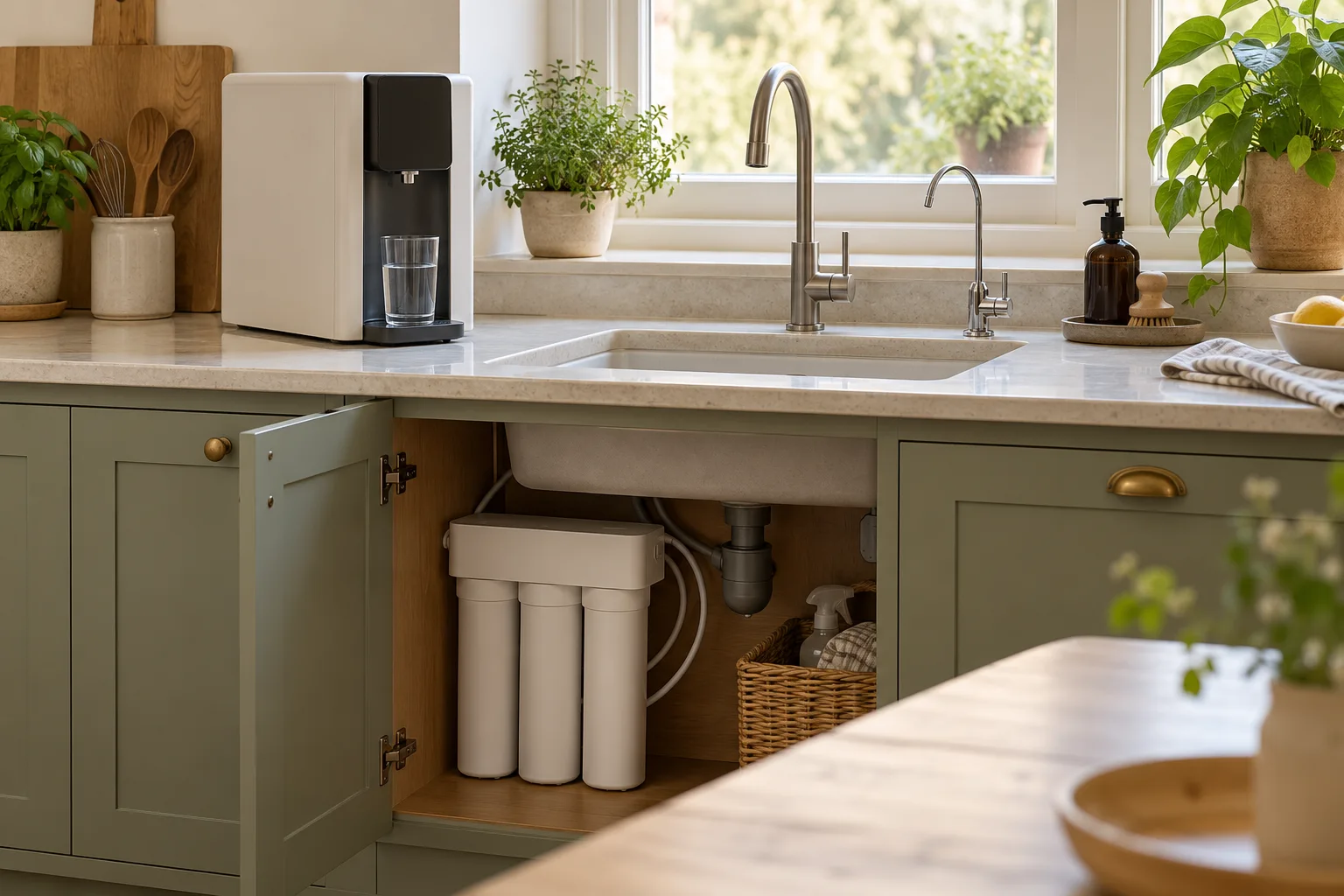
Start with the work each format asks you to do
Countertop and under-sink reverse osmosis can address similar treatment goals, but they ask very different things of the kitchen. A refillable countertop unit takes fresh feed water from a removable tank. A plumbed system takes it from a suitable supply connection and sends concentrate to an approved drain arrangement. Both need maintenance, replacement filters and a source within the exact model’s limits.
This is a comparison of ownership arrangements. For the underlying differences between carbon treatment and RO, use the technology comparison. Choosing a format does not establish which contaminants a particular model reduces, or turn a drinking-water filter into a whole-house softener.
| Question | Refillable countertop RO | Under-sink RO |
|---|---|---|
| Feed water | Carry and refill a tank | Permanent supply connection |
| Concentrate | Empty remaining feed water as directed | Suitable fixed drain connection |
| Space | Worktop, ventilation and tank access | Cabinet, fittings and service clearance |
| Moving home | Drain and prepare for transport | Removal and reinstatement may be needed |
Count your busiest serving period before comparing advertised litres. Several large bottles filled together can be more demanding than occasional glasses throughout the day. Record how much treated water must be ready, how quickly you need the next batch and who will deal with the refill afterwards.
Countertop RO avoids fixed plumbing but keeps the tanks
The selected C1H illustrates the compact countertop arrangement: a 3.2-litre feed tank, a separate one-litre pure-water vessel and an electrically heated dispensing function. Its feed capacity is not the volume of drinking water you can obtain from one fill. RO separates a treated stream from a more concentrated stream, while startup and maintenance flushes use additional water.
Waterdrop C1H hot countertop RO
A compact refillable RO appliance for a smaller worktop, with heating and a separate removable one-litre pure-water tank.
- Capacity / pack
- 3.2L feed · 1L pure tank
- System / cartridge
- C1RF
Good forCompact footprint and heated filtered water.
Watch forA feed-tank fill is not the same volume of ready drinking water.
Choose it when avoiding fixed plumbing matters and you can empty the concentrate, refill and clean the tanks regularly. It has no built-in chiller.
At the refill prompt, empty the remaining feed water before adding fresh tap water, as the manual directs. Continually topping up changes the intended routine and can increase the concentration presented to the membrane. Carrying a tank between sink and counter also needs a clear route, a manageable load and somewhere clean to put its lid.
This format can suit a renter or anyone avoiding permanent alterations. It still needs a suitable socket, dry positioning, ventilation and room to remove components. A hot-water function introduces its own cup clearance and burn precautions. A cold-water function adds cooling recovery and another operating mode to the electricity bill.
Under-sink RO shifts the work to installation and servicing
The selected G3P600 is a tankless under-sink example with separate replacement stages. It requires an installation plan for feed, concentrate drainage, power and dispensing. Tankless describes its storage arrangement; it does not mean the appliance has no service requirements or delivers unlimited water at any pressure and temperature.
Waterdrop G3P600 tankless RO system
A dedicated-outlet under-sink reverse-osmosis system with separate CF, CB and G3P600-RO consumables.
- Technology
- Reverse osmosis
- Water path
- Dedicated tap
- Services
- Power + drain
Good forFor a defined point-of-use RO requirement
Watch forCheck feed conditions, UK adapter, drain plan and every refill.
Consider for a defined treatment objective and a suitable potable feed. Requires a drain connection, power and the correct UK installation; it is not a whole-house softener.
Check the complete product manual with an appropriate installer before ordering. Identify the supply valve, permitted connection, drain arrangement and access for isolation. Ask who will make any tap or worktop opening, whether permission is required and how the installation can be removed or maintained later. Use the installation planning checklist to organise those questions.
Leave the required clearance to remove each cartridge without dismantling the cupboard. Pipework, bins, a waste trap and appliance hoses compete for the same space. A cabinet photograph with an empty floor is not representative of every fitted kitchen. The under-sink measuring guide helps turn nominal body dimensions into a usable service position.
Compare cleaning tasks and exact replacement stages
For countertop ownership, list feed-tank washing, pure-water storage care, float and screen cleaning, drip-tray emptying and the correct flush after replacement or non-use. Keep those as separate tasks. A low TDS display cannot tell you that a tank is hygienically clean, and replacing a membrane cannot clean a neglected receiving vessel.
Waterdrop C1RF replacement · 1 pack
The exact C1RF replacement family named for the selected Waterdrop C1H countertop reverse-osmosis system.
- Capacity / pack
- One replacement cartridge
- System / cartridge
- C1RF
Good forMaintaining the selected C1H system.
Watch forComplete the specified flush after fitting; a new filter is not ready straight from its wrapper.
Buy by the C1RF code rather than the shared CoreRO name. C1RFG mineralising filters are a different listing and should not be assumed equivalent.
For an installed system, make a filter schedule from the exact manual. Different stages can have different calendar and capacity limits. A six-month prefilter and a longer-life membrane cannot be priced as though the entire system takes one identical annual cartridge. Include flushing and any service labour in the plan.
Waterdrop G3-N1CF prefilter · 1 pack
The CF pre-sediment/carbon replacement for supported Waterdrop G3, G3P600 and G3P800 systems.
- Stage
- CF prefilter
- Code
- G3-N1CF
- Pack
- 1 cartridge
Good forMaintaining a supported G3-family prefilter
Watch forFollow its own time, volume and water-condition limits.
Confirm G3-N1CF against the exact system. This is one prefilter, not the RO membrane or a complete three-stage refill set.
The linked G3-N1CF is a prefilter stage, not a complete set or the G3P600 RO membrane. Confirm all the other required stages in the existing RO technology guide and the product manual. Similar cylindrical housings and a shared brand do not establish replacement compatibility.
Make a fair cost and convenience decision
Compare purchase price, any installation and reinstatement, replacement stages, electricity, water and drainage charges over the same period. Use current offers only when you are ready to buy. A discounted first cartridge does not establish the ongoing cost, and a nominal long service life depends on the actual water and demand.
Treat published recovery ratios consistently. A 3:1 treated-to-concentrate ratio means three parts treated plus one part concentrate under the specified conditions, before allowing for flushes. It cannot be compared with a ratio written in the opposite order. Nor does a favourable ratio eliminate the inconvenience of repeatedly carrying a countertop tank.
Choose countertop when avoiding plumbing is worth the refill and cleaning routine. Choose under-sink when a suitable installation can remove an inconvenient daily task and remain serviceable. If the main concern is taste rather than dissolved-salt reduction, check whether you need a filter before taking on RO’s extra equipment and upkeep.
Common questions
Does countertop RO need a drain connection?
The refillable models discussed here do not need a fixed drain connection. They still produce concentrate that must be emptied as directed; installation-free does not mean reject-water-free.
Can a renter choose under-sink RO?
Possibly, with the relevant permission and a suitable installation plan. Check tap or worktop changes, feed connection, drainage, electricity and reinstatement requirements before ordering.
Is under-sink RO always faster at filling a glass?
No. Compare the exact system’s delivery and storage arrangement. Nominal membrane production, pressure, temperature and tap delivery are different measures.
Does under-sink RO automatically provide boiling water?
No. Filtration, heating and chilling are separate functions. The selected G3P600 is an RO system, not a hot-water appliance.
Which format is cheaper to run?
There is no universal winner. Compare current filter prices, actual replacement schedules, electricity, water and drainage charges, installation and the time spent on daily tank care.
Sources and further reading
- Waterdrop: C1H UK/EU user manual, tank handling and flushing
- Waterdrop: WD-K19-HG-UK manual, settings, feed-tank cleaning and emptying
- Waterdrop: A2 manual with UK section, specifications and flush procedure
- Waterdrop UK: G3P600 installation and separate filter stages
- US EPA WaterSense: point-of-use RO and concentrate-water considerations