
Under-sink technology comparison · Ad
Under-sink carbon filtration vs reverse osmosis
Compare carbon and RO by treatment aim, minerals, reject water, power, fitting requirements and separate filter-stage costs, with exact system examples.
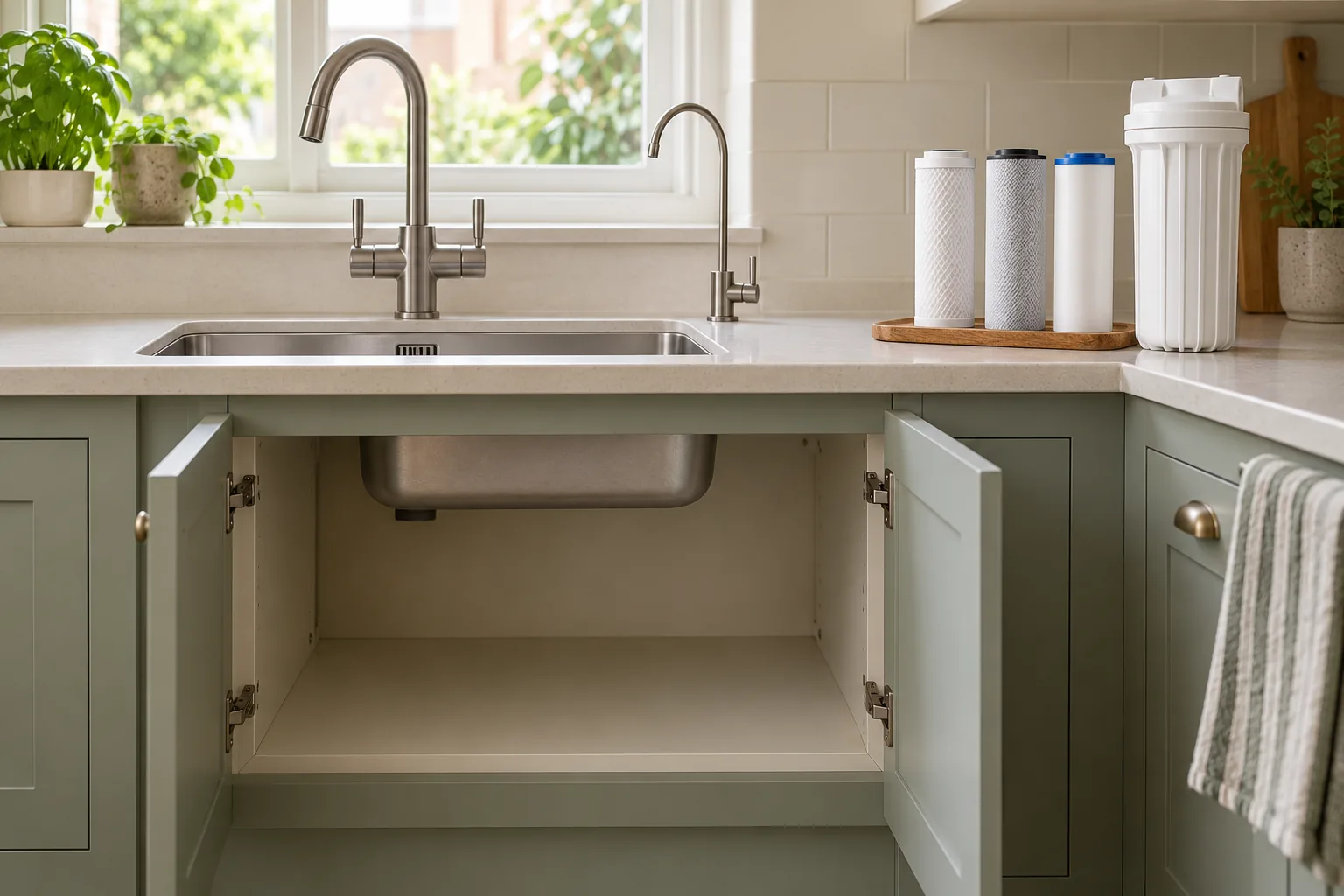
Carbon and RO are different treatment choices, often used together
An under-sink carbon system typically passes water through media intended for named taste or other reductions. It should not be assumed to remove hardness minerals or every dissolved substance. Its exact performance depends on the cartridge, flow and evidence rather than the location of the housing.
RO uses pressure to pass water through a semi-permeable membrane, producing a treated stream and a concentrate stream sent to drain. Household RO systems commonly also use sediment and carbon stages. “Carbon versus RO” therefore compares a simpler carbon-led arrangement with a membrane system that may itself contain carbon.
Start with a defined goal. For a compliant public supply and a familiar chlorine-taste preference, suitable carbon treatment or a simple chilled-water routine may be sufficient. A named dissolved-substance objective needs the exact performance evidence; a low TDS display alone does not establish a health benefit.
| Question | Carbon-led system | Reverse osmosis system |
|---|---|---|
| Dissolved minerals | Often substantially retained | Membrane reduces many dissolved ions |
| Specific reductions | Only those supported for the cartridge/system | Only those supported for the exact membrane/system |
| Water path | Existing cold tap or dedicated branch, model dependent | Commonly a dedicated treated-water outlet |
| Water to drain | No continuous RO reject stream; flushing still applies | Concentrate plus any automatic or service flushing |
| Power | Some simple systems need none | Many pumped tankless models need power |
| Consumables | One or more named media stages | Prefilter, carbon and membrane schedules may differ |
When an existing-tap carbon system is worth assessing
If the aim is an established taste preference and you want the main tap head unchanged, an appropriate under-sink carbon system may be simpler than a membrane installation. Check whether it treats all cold water at that tap or a dedicated branch; throughput changes the cartridge budget.
Waterdrop WD-10UA direct-connect system
An under-sink system feeding the existing cold kitchen tap, using the RF10 replacement family.
- Water path
- Existing cold tap
- Replacement
- WD-RF10
- Fit check
- Confirm UK connectors
Good forConsidering an existing-tap water path
Watch forNPT and BSP are different; do not force mismatched fittings.
Only order after the supplier and installer confirm the exact UK pack connections and their thread standard. BSP and NPT compatibility must not be inferred from nominal diameter.
The WD-10UA is an existing-tap example with an RF10 refill family. Before ordering, confirm the supplied UK connections with the supplier and installer. Waterdrop’s corporate UA documentation specifies NPT threads; a familiar nominal diameter does not prove BSP compatibility. Do not force mismatched fittings or assume a diameter converter changes the thread standard.
The standard 10UA carbon model is distinct from a 10UA-UF version and should not inherit that variant’s membrane claims. It also should not be described as an RO system or as producing low-mineral water. Read the under-sink choosing guide for its water-path and access checks.
For a specific contaminant, carbon may or may not be appropriate depending on the exact evidence. Avoid broad claims that carbon removes everything organic or that it can never reduce a named metal; the complete cartridge and its certification determine the supported claim.
What changes with a G3P600-style membrane system
The G3P600 is a tankless under-sink RO example with a dedicated faucet, electrical supply and drain connection. Confirm the selected UK pack, adapter, feed requirements and tap mounting before installation. Tankless removes a storage tank from the layout; it does not remove the need for cartridge access and suitable services.
Waterdrop G3P600 tankless RO system
A dedicated-outlet under-sink reverse-osmosis system with separate CF, CB and G3P600-RO consumables.
- Technology
- Reverse osmosis
- Water path
- Dedicated tap
- Services
- Power + drain
Good forFor a defined point-of-use RO requirement
Watch forCheck feed conditions, UK adapter, drain plan and every refill.
Consider for a defined treatment objective and a suitable potable feed. Requires a drain connection, power and the correct UK installation; it is not a whole-house softener.
IAPMO’s current WC-13976 listing identifies WD-G3P600 with the WD-G3P600-RO component for specified NSF/ANSI 58 reductions. The certification guide shows how to read that row without borrowing claims from another model or mistaking production rate for service capacity.
RO changes mineral composition, so consider why that change is wanted rather than treating the lowest display value as the universal objective. DWI cautions against assuming RO is a routine requirement for domestic mains water. If mineral addition or blending is proposed, identify the actual component and its effect on the final water; do not assume the standard pack includes it.
Use only feed water that meets the exact system instructions. A consumer RO purchase is not a general solution for untreated or unknown private-supply water, nor does its certification cancel an official water-use notice.
Read the ratio in the right direction and include flushing
Waterdrop advertises a 2:1 treated-water-to-drain ratio for G3P600 under the relevant conditions. That means an illustrative two litres of product water for one litre of concentrate, not two litres wasted for every litre produced. The actual ratio can vary with feed conditions and operation.
At that stated ratio, two litres of product plus one litre to drain means three litres of feed water, or about 67% recovery during that production example. It is not a promise about the household’s total annual efficiency: start-up, automatic and maintenance flushing can add water use.
For an illustrative four litres of treated demand a day, the ratio alone would imply about two litres of concentrate and six litres of feed, before those other uses. Use your supplier’s metered charges and the manufacturer’s applicable figures when budgeting. Do not apply one model’s advertised ratio to every RO system.
EPA WaterSense explains that RO designs differ substantially in water use and that other treatment can be sufficient for some aims. Its programme is a US scheme; mentioning its guidance does not claim this selected UK listing has a WaterSense label.
Price CF, CB and the membrane as separate consumables
The G3P600’s CF prefilter, CB carbon stage and RO membrane have different jobs and schedules. Waterdrop gives calendar maxima of six months for CF, twelve months for CB and twenty-four months for the G3P600-RO membrane, subject to earlier rated-volume or water-condition requirements. The longest headline is not a whole-system change interval.
Waterdrop G3-N1CF prefilter · 1 pack
The CF pre-sediment/carbon replacement for supported Waterdrop G3, G3P600 and G3P800 systems.
- Stage
- CF prefilter
- Code
- G3-N1CF
- Pack
- 1 cartridge
Good forMaintaining a supported G3-family prefilter
Watch forFollow its own time, volume and water-condition limits.
Confirm G3-N1CF against the exact system. This is one prefilter, not the RO membrane or a complete three-stage refill set.
G3-N1CF is the prefilter. A one-cartridge purchase does not include the post-carbon or membrane stages. Keep its code and its own fitting record, including any earlier limit in the supplied instructions.
Waterdrop G3-N3CB carbon filter · 1 pack
The CB activated-carbon replacement for supported G3, G3P600 and G3P800 systems.
- Stage
- CB carbon
- Code
- G3-N3CB
- Pack
- 1 cartridge
Good forMaintaining the supported carbon stage
Watch forA 12-month headline remains subject to volume and conditions.
Check the G3-N3CB code and approved system combination. A carbon-stage change does not renew the membrane or CF prefilter.
G3-N3CB is the separate carbon replacement. Do not assume changing it renews the other stages or that a normal TDS reading proves it can stay beyond its service limit.
Waterdrop G3P600-RO membrane · 1 pack
The named RO replacement membrane for the G3P600 system, distinct from the older G3 membrane.
- Stage
- RO membrane
- Code
- G3P600-RO
- Pack
- 1 cartridge
Good forReplacing a supported G3P600 membrane
Watch forThe 24-month maximum does not apply to CF or CB filters.
Use with the approved G3P600 system. The matching model and membrane appear in IAPMO listing WC-13976; exact certified claims and conditions still matter.
G3P600-RO is the model-specific membrane. It differs from the older G3 membrane despite the related names. Compare a complete year’s or two years’ planned replacements, then add fitting, electricity, water and any professional service cost. A bundle labelled “one year” needs its actual cartridge counts checked.
Resolve the kitchen and supply questions before ordering
Ask a competent installer to assess the cold feed, pressure, UK connectors, drain arrangement, power and outlet location against the selected manual. Keep drain and drinking-water paths appropriately designed; do not copy an online hose photograph as an installation plan.
Contact the water supplier before a mains-connected RO installation about notification and consent requirements for the work and UK nation. Agree permission for plumbing, mounting and any worktop alteration. The planning checklist and space worksheet help make the quote specific.
Choose carbon where its supported functions meet the aim with a manageable routine. Choose an appropriate RO system only when its defined treatment objective justifies the extra water path, services and maintenance. The technology name is the start of that decision; the exact product, installation and ongoing care determine what you will own.
For the practical ownership decision, compare countertop versus under-sink RO. Refillable models and their exact replacements are in the countertop RO buying guide.
Owners of the named RO example can use the G3P600 replacement guide. An optional remineralisation stage performs a separate job and does not replace the membrane.
Common questions
Does carbon alone remove all dissolved minerals?
No. A carbon-led taste system often retains most mineral ions. Check any additional media and the exact claims rather than assuming it behaves like RO.
Does an RO system contain carbon too?
Often yes. Carbon and sediment stages commonly work alongside the membrane, with separate replacement requirements.
What does a 2:1 treated-to-drain ratio mean?
Two parts treated water to one part concentrate under the stated conditions. Other flushing and actual feed conditions affect total water use.
Can a 24-month membrane headline apply to every stage?
No. G3P600’s CF and CB stages have different maxima and can need earlier replacement under their own volume or condition limits.
Is the lowest TDS reading automatically the best choice?
No. Define the treatment objective and verify the relevant evidence. A display reading is not a general health ranking or proof of every reduction claim.
Sources and further reading
- Drinking Water Inspectorate: domestic filters and softeners (England and Wales)
- US EPA WaterSense: point-of-use RO, reject water and treatment choices
- Waterdrop UK: G3P600 system, water path and installation requirements
- Waterdrop UK: G3P600 filter families and separate service schedules
- IAPMO R&T: current WC-13976 listing, including WD-G3P600 and its membrane
- Water Regs UK: installation and notification questions