
Filter technology comparison · Ad
Activated carbon vs ion-exchange water filters
Understand carbon adsorption, ion-exchange resin, combined jug cartridges and regenerating softeners, with practical examples and maintenance limits.
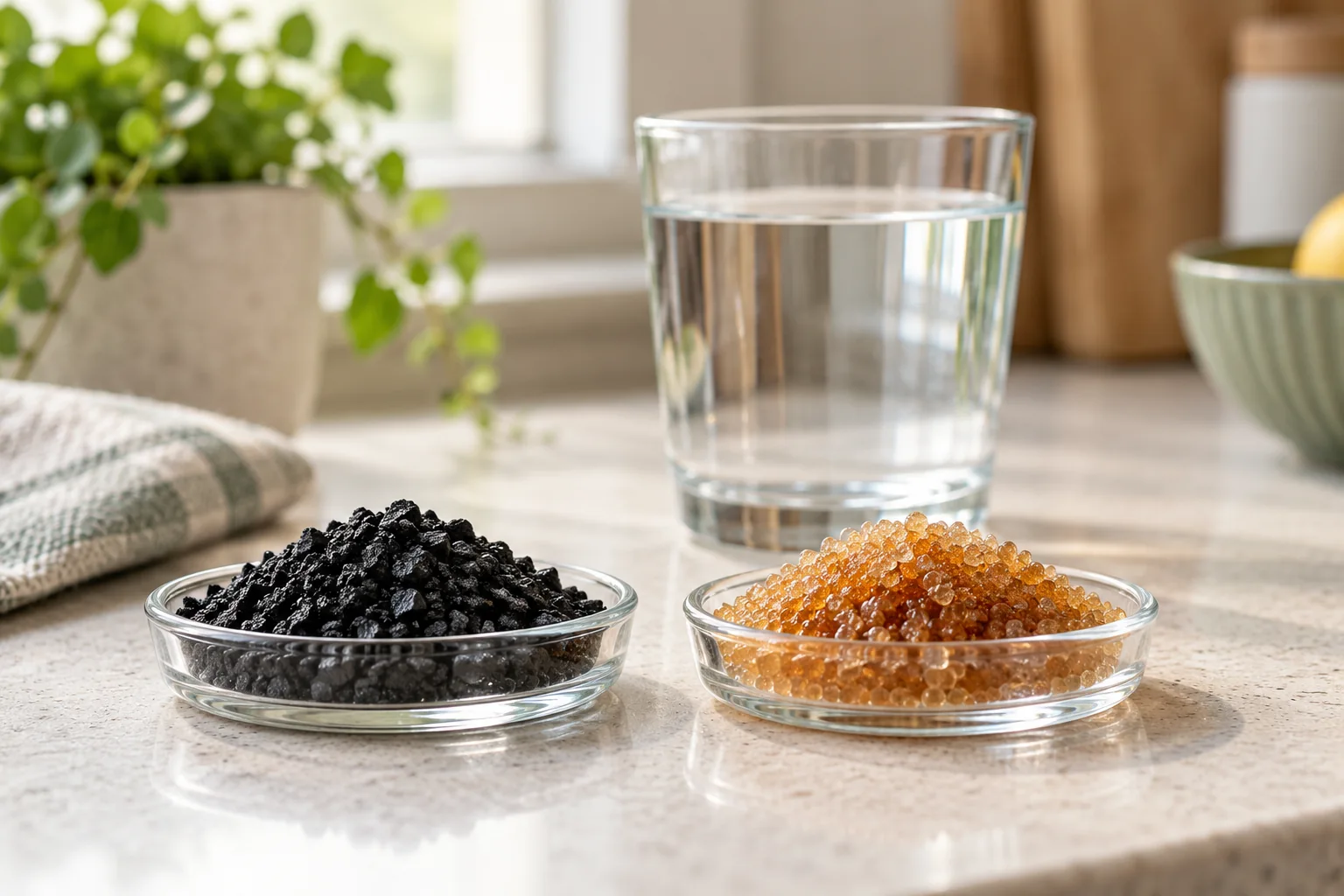
Two processes that should not be reduced to a mesh size
Activated carbon provides a large internal surface on which suitable substances can be held. This is usually described as adsorption: material collects at surfaces rather than simply being caught because every particle is larger than a hole. Carbon is commonly used for chlorine-related taste and odour and can be designed for additional named reductions.
Ion-exchange media contain sites that exchange certain ions in the water for others associated with the resin. The chemistry controls which exchanges are useful. A conventional sodium-regenerated softener targets hardness minerals, while a different resin may target particular metals or anions. “Contains resin” is therefore an incomplete description of a filter’s purpose.
Both processes have finite working capacity and depend on conditions such as water composition, contact and use. A housing can also contain screens or membranes, but their presence is a separate part of the treatment. A small printed pore size does not summarise carbon adsorption or resin selectivity.
| Question | Activated carbon | Ion exchange |
|---|---|---|
| Basic process | Adsorption and substance-specific interactions | Exchange of selected dissolved ions |
| Common household purpose | Taste/odour and named reductions | Hardness or particular ion reduction, depending on media |
| Hardness expectation | Do not assume carbon alone softens | Only where that resin is designed for the purpose |
| Dissolved-solids reading | May change little | Can remain similar when ions are exchanged |
| Maintenance | Replace or service as the exact system requires | Replace media or regenerate only in systems designed for it |
Why a jug can use carbon and resin together
A jug cartridge can combine carbon with resin so a single refill serves more than one practical aim. Carbon can address taste-related substances while suitable ion-exchange media alter aspects of hardness or target stated ions. The blend, amount of media and rated conditions determine what that particular cartridge claims.
This explains why a cartridge can be useful without producing near-zero dissolved solids. Removing every mineral is not the universal objective of jug filtering. Use the taste versus limescale guide to decide which function matters most before comparing compatible packs.
BRITA MAXTRA PRO Pure Performance · 6 pack
The everyday-purpose MAXTRA PRO replacement for compatible BRITA jugs and Flow. Compare this six-pack with the cartridges already included in your chosen starter bundle.
- Pack
- 6 cartridges
- Family
- MAXTRA PRO
- Limit
- 150L / 4 weeks
Good forRestocking a compatible MAXTRA PRO system.
Watch forFour weeks can arrive long before 150 litres.
Check the MAXTRA PRO family against your jug instructions. It is not a replacement for BRITA Classic, MicroDisc or ON TAP cartridges.
Pure Performance is an example of a combined-purpose refill for supported MAXTRA PRO vessels. It is not a loose-media kit or a regenerating softener. Follow its own preparation and replacement instructions; you cannot restore it by adding table salt, washing it with detergent or opening the sealed shell.
If scale is the priority, compare the Limescale Expert alternative. Do not infer that two refills with the same outline have identical resin chemistry, contact conditions or capacities.
Not every ion-exchange filter removes hardness
A useful counterexample is BRITA ON TAP. BRITA describes ion-exchanger media for stated metal reductions while deliberately retaining calcium and magnesium. A resin-containing tap cartridge therefore should not be called a softener just because ion exchange is part of its treatment.
BRITA ON TAP V-MF · 2 pack
A two-cartridge replacement pack for the compatible ON TAP family. Keep the V-MF name alongside the system model when comparing refill listings.
- Pack
- 2 cartridges
- Type
- ON TAP V-MF
- Limit
- 600L / 4 months
Good forKeeping the tap filter supplied after its initial cartridge.
Watch forNot a jug refill; check your system generation.
BRITA lists cross-compatibility with ON TAP V, Pro V-MF and the earlier HF with digital display. It excludes ON TAP versions from before 2019.
The V-MF cartridge also includes a membrane. Its membrane-related specification belongs to that installed refill; it does not make every other ON TAP cartridge equivalent. Check the housing generation and cartridge family before ordering.
The same caution applies to other selective media. A claim for one metal is not proof of reduction for every metal, and a nitrate-targeting resin should not be assumed to solve a chlorine taste preference. Look for the exact named substance and the evidence for the system in which the media are used.
Do not use a general statement that resin “removes impurities” to predict a TDS result or a health outcome. Exchange can change which ions are present without removing dissolved material in the way a deionisation system is intended to. The TDS guide explains the measurement boundary.
A salt-regenerated system is a different ownership commitment
A conventional domestic softener exchanges calcium and magnesium for sodium, then uses a controlled brine-regeneration cycle to restore the resin for further use. That is an engineered system with a valve, drainage, salt storage and operating settings. It is not a procedure to copy onto a sealed drinking-water cartridge.
BWT WS455 electronic water softener
A UK domestic ion-exchange softener using block or tablet salt, with electronic control and regeneration.
- Resin volume
- 10L
- Salt
- Block or tablet
- Control
- Electronic
Good forFor an assessed whole-home scale concern
Watch for10 litres is resin volume, not a drinking-water reservoir.
For an installer-assessed hardness-reduction plan. Retain an appropriate unsoftened drinking-water supply; confirm drain, overflow, power, fittings and salt access.
The BWT WS455 is a UK installation example with electronic control and block or tablet salt. Its 10-litre specification describes resin volume, not a ten-litre drinking-water tank. An installer should assess demand, local hardness, plumbing and service requirements rather than sizing it solely from the number of residents.
Follow UK guidance on retaining an appropriate unsoftened drinking-and-cooking outlet when installing a sodium-exchange softener. A downstream carbon taste cartridge does not remove the sodium added by that exchange process. Read the filter-versus-softener comparison for the water-path decision and maintenance budget.
Buy the specified function and keep its limits visible
When reading a product page, separate the media description from the verified performance claim. “Coconut-shell carbon” names a material; it does not by itself show a certified reduction for your concern. “Ion-exchange resin” names a process family; it does not tell you whether the selected cartridge targets hardness, metals or something else.
For a named reduction, check the exact model, replacement component, conditions and certifier’s listing. The claim-verification guide explains the difference between a test report, a product listing and material-safety approval. Avoid carrying one cartridge’s claims across to a cheaper compatible refill without evidence.
Then create the practical schedule. Time, rated volume and water conditions can all govern replacement. An apparently normal flow or pleasant taste cannot establish that every stated function remains within its service limit. Cleaning the container or resetting an indicator does not renew the media.
Choose the process for the intended outcome and the supported water conditions. Household filters discussed here are not a general method for making unknown or microbiologically unsafe water suitable; follow supplier notices and use supply-specific professional advice where needed.
Common questions
Is adsorption the same as mechanical sieving?
No. Adsorption involves substances held at surfaces. A filter may also have screens or membranes, but a mesh size alone does not describe its carbon performance.
Does every ion-exchange resin soften water?
No. Resin chemistry determines the target ions. Some media reduce particular metals while retaining calcium and magnesium.
Can I regenerate a sealed jug cartridge with salt?
No. Regeneration belongs to equipment specifically designed and controlled for it. Follow the jug cartridge’s replacement instructions.
Does a softener remove all dissolved solids?
A conventional sodium-exchange softener swaps hardness ions for sodium. It is not deionisation and should not be expected to produce near-zero TDS.
Can carbon and resin be used in one cartridge?
Yes. Combined-media cartridges are common, but their exact functions, capacities and compatibility must be checked for the named refill.
Sources and further reading
- NSF: what water-treatment standards cover and their claim limits
- Drinking Water Inspectorate: domestic filters and softeners (England and Wales)
- Drinking Water Inspectorate: hardness, scale and softening
- BRITA: ON TAP treatment retains calcium and magnesium
- BWT UK: WS455 softener, installation and salt requirements