
Water treatment comparison · Ad
Water filter vs water softener: what each changes
Compare taste filtering, point-of-use scale cartridges and salt-regenerated softeners, including sodium, drinking-water outlets, installation and ongoing costs.
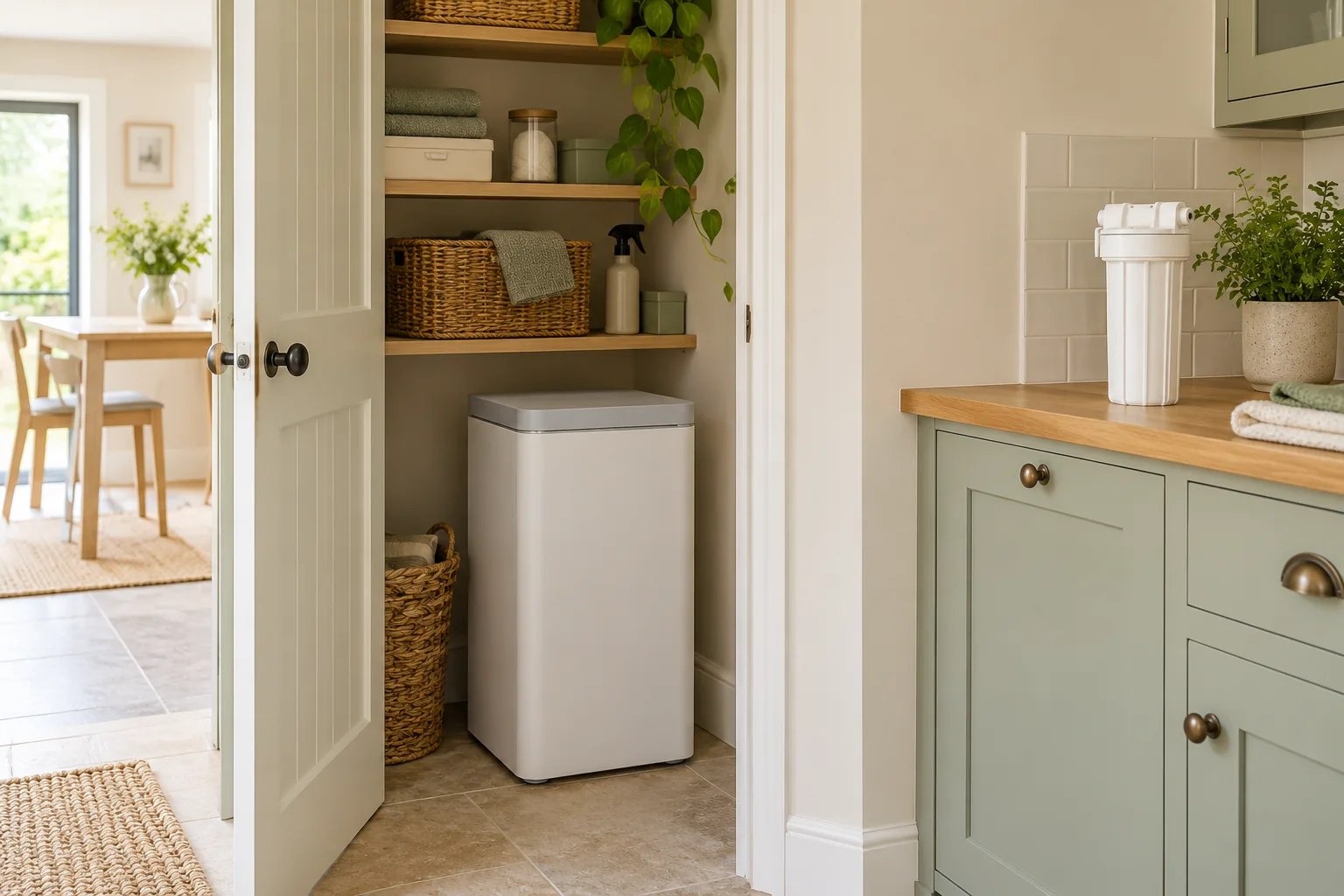
“Filter” describes too many products to be the whole answer
A household filter can mean a taste cartridge, a ceramic element, a combined carbon-and-resin jug refill or an RO system. Their functions differ. A water softener usually means an installed ion-exchange system intended to reduce calcium and magnesium hardness in the plumbing it serves.
Start with the practical concern and its location. A kettle-scale aim may be limited to water poured into that appliance. Scale around showers and hot-water equipment is a wider household question. A chlorine-related taste preference is different again and does not automatically call for softening.
| Option | Main role | Typical footprint | Main ownership issue |
|---|---|---|---|
| Carbon taste filter | Named taste/chlorine-related reductions | Jug or connected drinking-water outlet | Correct cartridge, hygiene and service limits |
| Scale-focused jug cartridge | Stated carbonate-hardness/scale function | Water passed through the jug | No effect on the rest of the plumbing |
| Sodium-exchange softener | Reduce calcium/magnesium hardness | Connected domestic water distribution | Salt, regeneration, drainage and drinking outlet |
| Point-of-use RO | Membrane treatment for specified dissolved substances | Dedicated treated-water branch | Reject water, maintenance and model conditions |
The word filter does not promise disinfection, and a softener should not be treated as a general contaminant-removal device. Use the technology comparison if you need to separate the underlying processes.
A sodium-exchange softener changes hardness ions
A conventional domestic softener exchanges calcium and magnesium for sodium. It then regenerates the resin using a controlled brine cycle. The useful result is lower hardness in the water it supplies, with potential reductions in new scale and soap-related deposits under suitable conditions.
This is not the same as removing every dissolved solid. A TDS estimate can remain broadly similar after softening because the process exchanges ions. A low TDS result is neither the expected proof of correct operation nor a substitute for a hardness-specific check and the installer’s commissioning record.
Salt is used to regenerate the system; it is not a consumable to pour into an ordinary sealed jug cartridge. Correct operation requires the right salt form, settings and maintenance. The drain and overflow arrangements also have different purposes and need to follow the exact installation instructions.
BWT WS455 electronic water softener
A UK domestic ion-exchange softener using block or tablet salt, with electronic control and regeneration.
- Resin volume
- 10L
- Salt
- Block or tablet
- Control
- Electronic
Good forFor an assessed whole-home scale concern
Watch for10 litres is resin volume, not a drinking-water reservoir.
For an installer-assessed hardness-reduction plan. Retain an appropriate unsoftened drinking-water supply; confirm drain, overflow, power, fittings and salt access.
The WS455 is an example of a UK electronic softener accepting block or tablet salt. Its 10-litre figure is resin volume, not water ready to drink. Have an installer assess demand, hardness, pressure, services and access. A household-size marketing description is not a complete sizing calculation for every home.
Retain an appropriate unsoftened drinking-and-cooking supply
DWI advises retaining an unsoftened supply for drinking and cooking when a sodium-exchange softener is installed. Agree that water path with the installer before the work is done. A clearly identified outlet is easier for a household to use correctly than an undocumented bypass arrangement.
Artificially softened water should not be used to prepare baby feeds. Follow the relevant NHS feeding guidance and the supplier’s water-use advice; a taste cartridge does not make softened water equivalent to the retained unsoftened supply. People with an individual sodium-related medical requirement should follow their clinician’s advice rather than a generic product claim.
An ordinary activated-carbon taste filter does not undo the sodium added by conventional softening. If you want taste filtering as well, plan it on an appropriate drinking-water branch and check the exact system’s feed conditions. Do not simply add another cartridge and assume every concern has been removed.
Some products use different exchange chemistry or are marketed as conditioners rather than softeners. Read the mechanism and evidence. A salt-free scale-management claim should not be relabelled calcium-and-magnesium removal without support.
When a jug or tap filter is the proportionate choice
For less new scale in kettle water, a compatible hardness-focused jug refill may be enough. It avoids changing the domestic pipework but brings the familiar refill, cleaning and cartridge-replacement routine. Its benefit is limited to the water actually filtered.
BRITA MAXTRA PRO Limescale Expert · 6 pack
A MAXTRA PRO option for a hard-water kettle-scale priority, without changing a compatible jug or Flow dispenser.
- Pack
- 6 cartridges
- Family
- MAXTRA PRO
- Limit
- 150L / 4 weeks
Good forComparing a scale-focused refill for a compatible jug.
Watch forWater conditions can shorten the stated maximum life.
BRITA positions this type for hard to very hard water. It treats the water you filter through the jug; it does not soften the whole household supply.
Limescale Expert is the scale-focused MAXTRA PRO option for supported vessels. It does not remove existing appliance deposits or soften the shower supply. Compare the hard-water jug guide before treating it as a smaller version of a whole-home softener.
For an established taste preference, an eligible tap-mounted system may remove the need for a separate jug. The treatment must still match the concern, and the tap needs the right outlet and adapters.
BRITA ON TAP V
A tap-mounted option for filtered drinking water without keeping a jug topped up. Its manual change reminder suits someone happy to track cartridge use.
- Position
- Tap outlet
- Reminder
- Manual
- Refill
- ON TAP V / V-MF
Good forAvoiding a separate jug on a compatible tap.
Watch forAdded bulk at the outlet and no hardness reduction.
Choose it only after checking the outlet and supplied adapters. Pull-out or spray taps need particular attention to the fit chart; the filter is not a limescale solution.
BRITA says ON TAP retains calcium and magnesium, so it should not be chosen for hardness reduction. Its metal-selective ion-exchange media do not make it a conventional softener. The taste-versus-scale explainer helps keep the expectations separate.
Compare two different maintenance budgets fairly
A jug budget includes the vessel, compatible media and routine cleaning. A tap attachment adds fitting and clearance checks. A softener budget includes the unit, survey and installation, ongoing salt, regeneration water, power where required and servicing. Do not compare one softener purchase price with one cartridge multipack as if they cover the same water volume and outlets.
Ask for expected operating costs based on the home’s actual hardness and use. Regeneration frequency and salt consumption depend on system settings and demand, so a single household example is not a guaranteed annual cost. Include a realistic plan for lifting salt and accessing the unit if mobility or storage is relevant.
Before installation, agree permission, the retained drinking route, backflow protection and any required water-supplier notification. Confirm how the model’s drain, overflow, electrical supply and isolation will be provided. Use our installation planning checklist as a set of questions, with the softener’s own manual controlling the details.
Choose a softener for an assessed wider hardness problem, a scale cartridge for an appropriate point-of-use aim, and a taste filter for the claim it actually supports. None is an automatic health upgrade to a compliant mains supply, and none replaces investigation of an unexpected water-quality change.
Common questions
Does every water filter soften water?
No. Some combined-media cartridges reduce hardness-related scale, while taste-focused products may retain calcium and magnesium. Check the exact function.
Does a softener remove all contaminants?
No. Conventional sodium-exchange softening targets hardness. It is not a general purification or disinfection process.
Will a carbon filter remove the sodium added by a softener?
Ordinary carbon taste filtering does not undo that sodium exchange. Plan an appropriate unsoftened drinking-water route with the installer.
Can artificially softened water be used for baby feeds?
DWI advises against it. Follow NHS preparation guidance and the relevant supplier advice; do not assume adding a taste filter resolves the issue.
Can I judge softening with a TDS meter?
A TDS estimate does not specifically measure hardness. Use the installer’s commissioning procedure and a suitable hardness value or test.
Sources and further reading
- Drinking Water Inspectorate: domestic filters and softeners (England and Wales)
- Drinking Water Inspectorate: hardness, scale and softening
- NSF: what water-treatment standards cover and their claim limits
- BWT UK: WS455 softener, installation and salt requirements
- BRITA: ON TAP treatment retains calcium and magnesium
- Water Regs UK: installation and notification questions