
Under-sink comparison · Ad
Direct-connect vs separate-tap under-sink filters
Compare existing-tap and dedicated-outlet under-sink filters: plumbing, drilling, cartridge use, three-way taps, UK connector checks and maintenance.
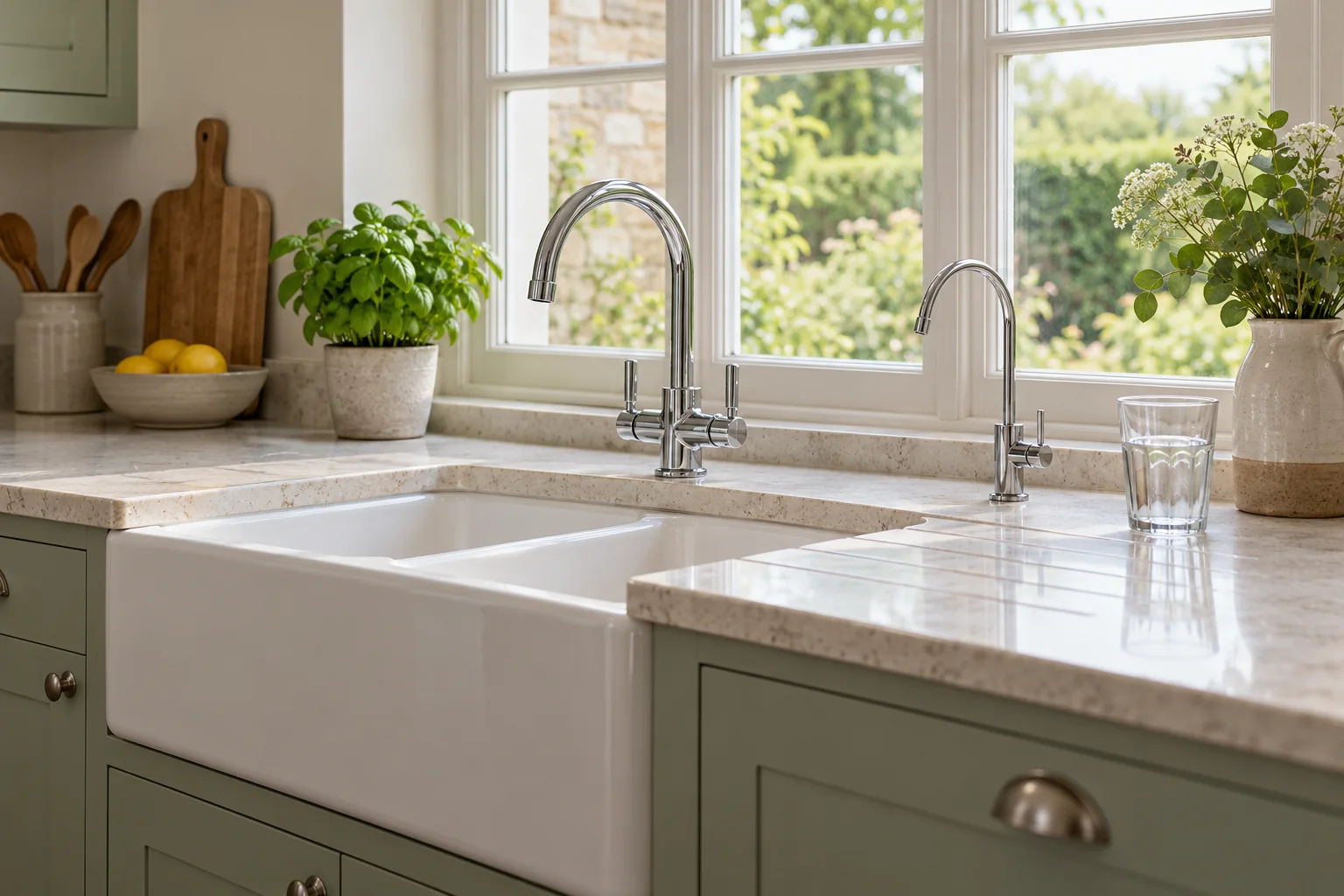
Trace the cold water from the supply to the glass
In a direct-connect arrangement, an approved filter is placed in the cold-water path serving the existing kitchen tap. When that cold side is used, water passes through the filter. The hot supply remains a separate plumbing path; mixing hot and cold at the spout does not mean the filter should be connected to a hot pipe.
A separate-tap arrangement branches the cold supply to a filter and then to a dedicated drinking-water tap. The ordinary kitchen mixer continues to provide its usual hot and cold water. This can make it easy to reserve cartridge capacity for drinking and cooking, provided everyone knows which outlet is filtered.
These are design arrangements rather than interchangeable hose positions. Use the model’s approved connection scheme. A housing intended to supply a small dedicated tap should not be assumed suitable for unrestricted flow to an ordinary mixer merely because an adapter can be purchased.
| Ownership question | Direct-connect | Separate filtered tap |
|---|---|---|
| Visible change | Usually keeps the existing tap head | Adds a tap unless a suitable three-way mixer is used |
| Typical filtered use | Cold water drawn at that tap | Water drawn from the dedicated branch |
| Worktop issue | Usually no extra tap hole for this arrangement | Suitable mounting hole and underside access needed |
| Consumable demand | Can include rinsing and cleaning use | Can reserve use for drinking and cooking |
| Key fitting check | Existing supply and tap-tail connections | Branch fittings, filter tubing and tap inlet |
When direct-connect is convenient
Keeping the existing tap can be attractive when the sink deck is crowded or you do not want another spout. There is no filter body hanging from the outlet, which can preserve clearance for pans and bottles. It also avoids asking people to select a tap-mounted attachment’s filtered mode each time.
That simplicity depends on the plumbing beneath the sink. Flexible tap tails, isolation valves and available mounting space vary between kitchens. A system that suits one existing mixer can still need additional approved connectors in another. Permission for a plumbing change remains relevant even when the worktop is not drilled.
Waterdrop WD-10UA direct-connect system
An under-sink system feeding the existing cold kitchen tap, using the RF10 replacement family.
- Water path
- Existing cold tap
- Replacement
- WD-RF10
- Fit check
- Confirm UK connectors
Good forConsidering an existing-tap water path
Watch forNPT and BSP are different; do not force mismatched fittings.
Only order after the supplier and installer confirm the exact UK pack connections and their thread standard. BSP and NPT compatibility must not be inferred from nominal diameter.
The WD-10UA is an example of an existing-tap system, but the selected pack must be checked for UK connection compatibility before ordering. Do not assume a 1/2-inch or 3/8-inch description establishes BSP or NPT compatibility. Have the supplier and installer confirm the actual mating parts and any approved transition required.
If most cold water at the tap is used for washing rather than drinking, count that volume in the refill calculation. An easy-to-use outlet can still be the more expensive water path if it processes far more litres than you intended.
When a separate filtered tap is worth the mounting work
A dedicated tap provides a clear drinking-water route and can leave the main mixer’s routine unchanged. The small outlet may fill more slowly than the existing cold tap; check the system’s expected flow under the intended supply conditions rather than assuming all taps deliver the same rate.
Check where a new outlet can be mounted, whether the spout reaches over the basin and whether its handle can operate fully. Below the worktop, there must be room for the fixing, tubing and future access. A neat location above the counter may be blocked by the sink bowl or reinforcement underneath.
Doulton HIP TRIO · tap & installation bundle
The selected Amazon bundle names HIP TRIO, limescale and fluoride prefilters, a Biotect Ultra ceramic stage, pillar tap and installation kit.
- Position
- Under sink
- Outlet
- Separate pillar tap
- Stages
- 3 filter positions
Good forKeeping filtration hardware off the worktop.
Watch forPlumbing work, tap placement and several consumables.
A dedicated filtered-water branch. Confirm the selected bundle includes all three named filters and the tap; the manufacturer’s configurable base pack differs.
The selected HIP TRIO Amazon bundle includes a pillar tap, while Doulton’s manufacturer base pack treats taps as a separate choice. Confirm the selected bundle’s contents and the installed inlet size. Doulton recommends its 3/8-inch tap connection and warns that smaller third-party inlet arrangements can restrict flow. That is a reason to verify the whole branch, not a reason to assume every 3/8-inch-looking fitting matches.
A three-way tap is a dedicated branch inside one tap body
For a complete example, the BRITA 3-way filter-tap guide covers the installed outlet, filter space and ownership costs. Compare the tap and filter kit together rather than treating a replacement tap body as the whole installation.
A compatible three-way mixer normally provides ordinary hot, ordinary cold and a separate filtered-water passage. It can reduce the number of visible taps, but the installation still needs an appropriate branch and a system approved for that connection. A single spout does not mean the supplies should be joined indiscriminately.
Compare tap and filter instructions together. Check the filtered inlet’s connection, flow suitability, mounting-hole requirement and the space needed for hoses below. Some kitchens have a suitable existing hole; others require a tap replacement or worktop work. Do not borrow a hole diameter from another brand’s tap.
Explain the controls to everyone using the kitchen. A filtered lever or marked control should have a clear purpose, and ordinary washing water should not accidentally consume the drinking-water cartridge allowance. Keep a record of the tap model alongside the filter model so future spare parts are ordered for the right component.
If the existing mixer is a pull-out spray design, an under-sink arrangement can avoid an attachment on the head, but it still needs a system and connection suitable for that mixer. The incompatibility of a tap-mounted device does not prove that any under-sink kit is suitable.
Compare actual filtered volume, then cartridge costs
Suppose a household uses four litres a day for drinking and cooking, plus another twelve litres of cold water at the kitchen tap for other tasks. A dedicated branch used only for the first group would process about four litres daily. A direct-connect installation on that cold supply could process around sixteen. These are illustrative assumptions, not a claim about a particular household’s consumption.
The difference matters where a cartridge reaches its volume limit before its calendar limit. It may matter less in a low-use installation where time arrives first. Record realistic use for several ordinary days and include bottles, food preparation and guests. Compare each cartridge against its own service instructions.
Waterdrop WD-RF10 · 1 pack
One RF10 replacement for the compatible WD-10UA/10UB family. It is a refill, not a complete installation kit.
- Pack
- 1 cartridge
- Family
- WD-RF10
- Fits
- Supported 10UA / 10UB
Good forMaintaining a compatible 10UA system
Watch forConfirm the supplied refill’s time and volume limits.
Confirm RF10 on the existing system. RF10-UF and longer RF15/RF17 names are distinct; do not choose by similar appearance.
The RF10 refill belongs to the supported WD-10UA/10UB family. Identify it before comparing prices, and keep the exact supplied pack’s rating rather than importing a longer cartridge’s capacity. For HIP TRIO, budget each prefilter and the ceramic stage separately.
Finally add installation, tap hardware, any approved conversion fittings and the cost of future service access. Read the installation checklist and space guide before deciding. A clear, maintainable water path is more useful than saving a little on a kit that needs repeated dismantling to change its filter.
Common questions
Does direct-connect filter the hot tap too?
The systems discussed are intended for the approved cold-water path. Do not connect one to a hot supply or assume mixed water at the spout changes its permitted feed conditions.
Does a separate tap always need a new hole?
It needs a suitable mounting location and hole, which may already exist. A compatible three-way mixer is another option, with its own installation requirements.
Is a three-way tap the same as filtering all cold water?
No. A suitable three-way design provides a dedicated filtered passage as well as ordinary hot and cold supplies. Check the exact tap and system arrangement.
Will direct-connect use cartridges faster?
It can if more water passes through it and volume becomes the limiting factor. Compare actual throughput and the earlier time or litre limit.
Can I swap one arrangement for another using an adapter?
Do not assume so. The filter, tap, flow requirements and approved connection scheme must all support the proposed arrangement.